
Plants & Animals
Bison in Poland
Where Europe’s largest land animal lives — and how it came back from the brink.
The European bison is Europe’s largest land animal — a species that once roamed almost the entire continent from Russia to Spain. Its numbers dwindled over the last millennium until only two populations survived: one in Białowieża Forest, and one in the Caucasus. Both eventually collapsed. War and empire drove the European bison to extinction in the wild, with the last individual killed in 1927.
A handful of individuals survived in zoos. A breeding programme was started immediately, but reintroductions had to wait until the horrors of the Second World War had passed. Finally, in 1952, the first bison were released back into the wild in Białowieża Forest. Other populations soon followed. The recovery has been one of the great conservation success stories of the 20th century — arguably even more remarkable than the recovery of the wolf. Astonishingly, every living European bison descends from just 12 individuals.
Where bison live in Poland
Poland is now the heartland of the European bison. The country holds more free-roaming bison than anywhere else in the world, with several distinct populations spread across its forests. Białowieża Forest remains the stronghold — the place where bison survived the longest and where the reintroduction began. Around 1,000 animals now roam the Polish side of the forest, with a further population on the Belarusian side. There is little mixing between the two herds, partly due to the border infrastructure separating them.
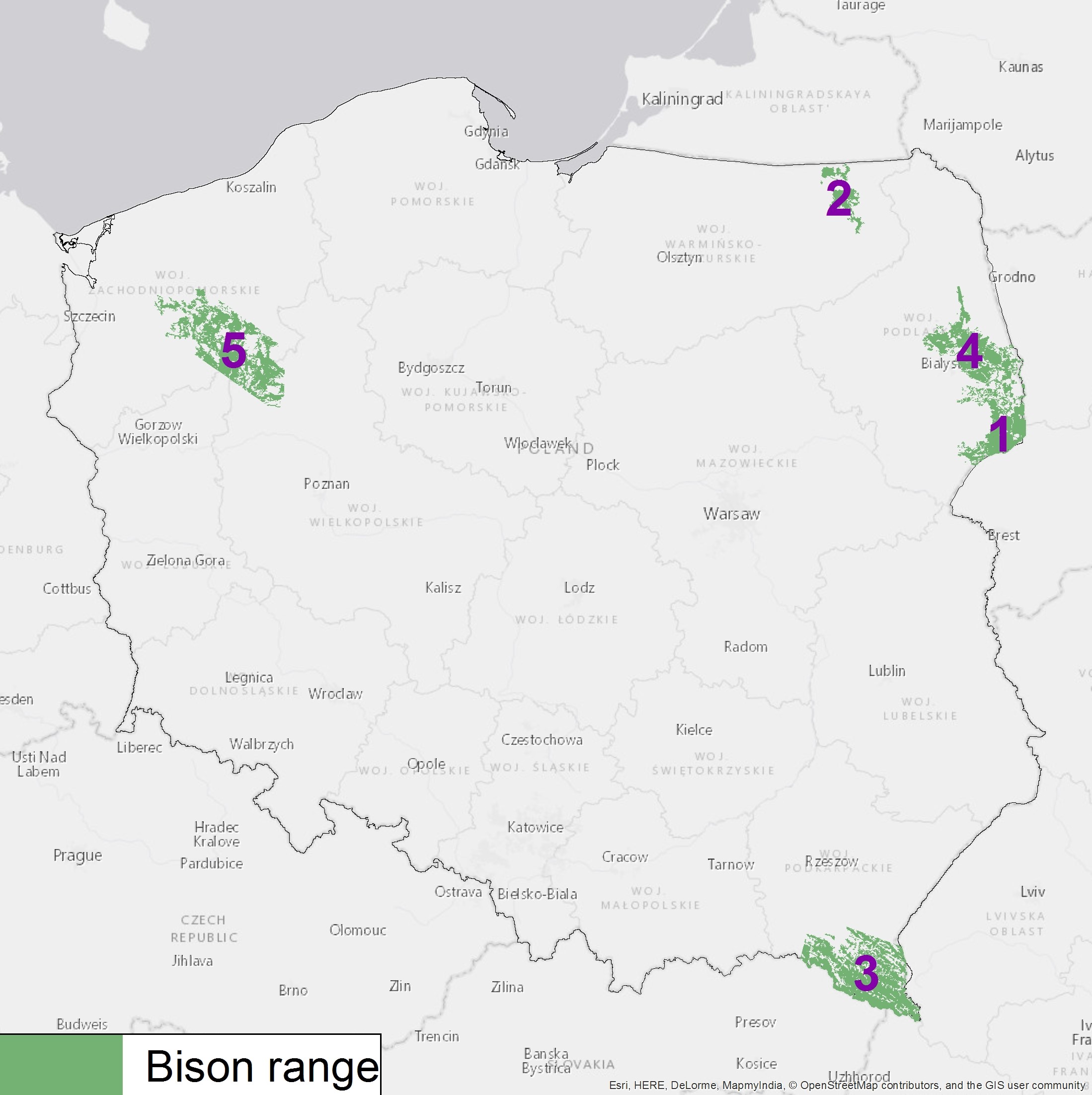
The table below shows Poland’s free-roaming bison populations, with 2017 and 2021 counts for comparison. Source: zubry.com.
| Population | Established | 2017 | 2021 |
|---|---|---|---|
| Puszcza Białowieska | 1952 | 600 | 779 |
| Puszcza Borecka (Borki Forest) | 1962 | 110 | 125 |
| Bieszczady Mountains | 1964 | 400 | 729 |
| Puszcza Knyszyńska (Knyszyn Forest) | 1973 | 150 | 212 |
| Stada w Zachodniej Polsce (Western Poland) | 1980 | 205 | 340 |
| Puszcza Augustowska | — | — | 20 |
| Wolisko | — | — | 8 |
| Lasy Janowskie | — | — | 9 |
| Puszcza Romnicka | — | — | 9 |
These populations are broadly fixed in place. Bison rarely venture far outside their home forests, despite research suggesting they were originally a plains species that migrated seasonally. Migrations are no longer possible — farmland forms an impenetrable barrier across the landscape. In winter, when forest food is scarce, supplementary hay is put out to prevent bison from stripping bark off trees or raiding agricultural land. Individuals that wander too far are typically captured and returned.
Lowland and highland bison
There are two distinct genetic lineages of European bison, kept separate to prevent interbreeding. Historically there were two subspecies: a lowland variety from Białowieża Forest, and a highland variety from the Caucasus Mountains. By the late 1920s, only one highland individual survived — a Caucasian male, who was crossed with a lowland female to produce a hybrid lineage. Wildlife managers have maintained the two lineages separately ever since. In Poland, only the Bieszczady population carries the highland-lowland crossbreed genetics; the other four free-roaming populations are purebred lowland bison. In practice there is little to tell them apart — minor differences in coat and hooves, little more.
Populations outside Poland
Free-roaming herds now exist in Lithuania, Belarus, Ukraine, Romania, Russia, Slovakia, Latvia, Kyrgyzstan and Germany, as well as in forest preserves in the Western Caucasus. The global population stands at around 6,500–7,000 animals, of which the vast majority are free-ranging. Poland and Belarus together account for roughly half the world total.
The most adventurous bison in history: While bison rarely stray far, exceptions occur. In 1981 a seven-year-old bull left his home in the Bieszczady Mountains and was first spotted in a forest 300 km to the north. He then vanished, evading capture for over a month, before reappearing bewildered in woodland near Warsaw — a journey of over 700 km in total. No bison has come close to matching it since.
Where do bison live in Poland?
The main population is in Białowieża Forest, which hosts the world’s largest free-roaming herd — around 1,000 animals on the Polish side alone. Major reintroduced populations also exist in the Bieszczady Mountains, Puszcza Knyszyńska, Puszcza Borecka, and across western Poland.
How many bison are there in Poland?
As of 2021 there were around 2,200 free-roaming bison in Poland across the main wild populations, plus several hundred more in enclosed reserves. Poland holds more European bison than any other country in the world.
How big is a European bison?
The European bison is the heaviest land animal in Europe. Adult bulls weigh 600–900 kg and stand around 180 cm at the shoulder. Despite their size they are agile and can move quietly through dense woodland. Cows are considerably smaller, typically 300–500 kg.
Were European bison ever extinct?
Yes — extinct in the wild since 1927, when the last individual was killed in Białowieża Forest. The species survived only in zoos. Reintroduction to the wild began in 1952, and all living European bison descend from just 12 individuals. Read the full story in The story of the European bison.
Where is the best place to see bison in Poland?
Białowieża Forest is by far the best place. The village of Teremiski and the meadows around Białowieża village are the most reliable spots. See the dedicated bison spotting guide for full details.
For more on Poland’s other large mammals, see the status pages for wolves, lynx and bears.
Go deeper
Explore the forest with an expert
Five days tracking wolves, finding bison and walking ancient old-growth — guided by a PhD ecologist.