
Plants & Animals
Bears in Białowieża Forest
Rare visitors and the complex history of bear reintroduction to Poland.
This article is based on a piece I originally wrote for the Notes from Poland news site. It documents the history, ecology and current status of bears in Białowieża Forest.
Białowieża Forest is Europe’s last primeval forest. The vast expanse of dense woodland on the border between Poland and Belarus is replete with moss-covered trees harbouring species extinct elsewhere. Yet, for all its well-preserved nature and successful efforts to reintroduce its iconic bison, since the Second World War the forest had been missing its largest carnivore — the bear.
Since its disappearance in 1947, people have speculated about the bear’s possible return. Several ideas were considered, including reintroduction or natural recolonisation from refuges in eastern Belarus, where the species still survives. But as decades passed with no signs of bears, hope was slowly abandoned.
Few people, therefore, could have expected what happened on 17 June 2019.
The day the bear showed up
On a pleasant June afternoon, I had just finished zig-zagging between my experimental plots scattered around the remote areas of the forest. When my phone signal returned, the screen lit up with a flurry of missed calls and a text message from my colleague: “We recorded a bear!”
A camera trap put up in the forest to film badgers had caught sight of a wandering bear. I raced back to the Mammal Research Institute to see the recording. We published the video that same afternoon, and soon after word spread like wildfire.
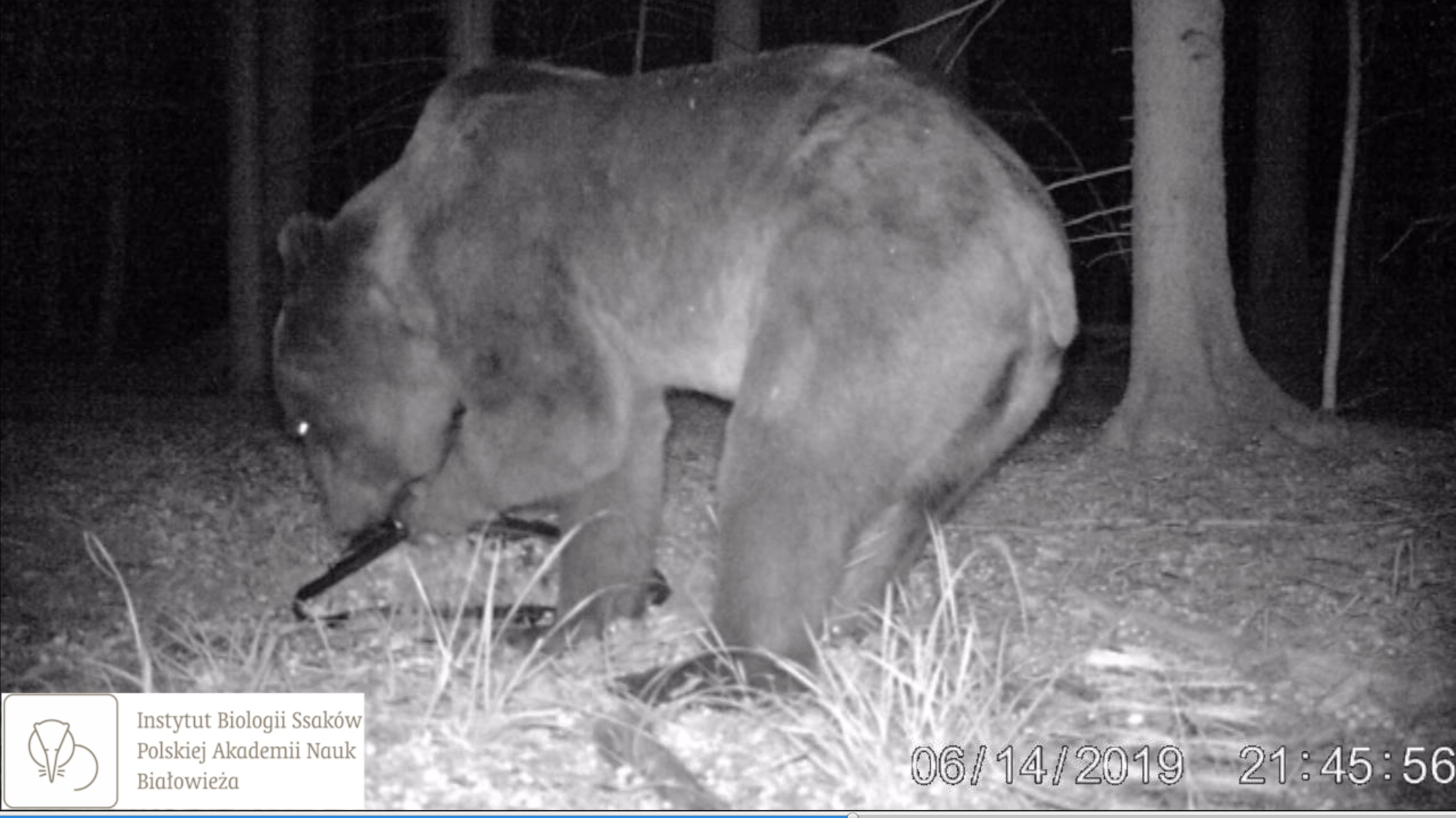
By that evening it had been broadcast on national television, shared thousands of times online, and chronicled across several news articles. It dawned on me that we were witnessing the latest chapter in the bear’s epic history in Białowieża Forest.
Amid the excitement, my colleagues and I began asking some important questions. Would bears soon permanently recolonise the forest? What effect would this have on the forest’s ecosystems and on local human society? In our quest for answers, we learned that the story of the bear in Białowieża Forest is perhaps one of the most unusual of any species anywhere — and closely intertwined with Poland’s own dramatic history.
The history of Białowieża’s bears
From the 14th century until the late 1700s, Białowieża Forest served as a private hunting ground for Polish-Lithuanian kings. The bear, alongside the European bison, was one of the most prized big game species reserved for royal hunts. The forest and its animals were strictly protected: settling, logging and hunting were forbidden. The sporting royals had created one of the world’s earliest conservation programmes, maintained for centuries — until the forest was annexed by Imperial Russia in 1795.
The new administration changed strategy. While the bison was still to be protected, the bear was recast as a pest to be exterminated. The population consequently dwindled until the last individual was killed in 1879 — the bear’s first extinction from Białowieża Forest.
The First World War ushered in the most tumultuous period in the forest’s history. The German occupiers disregarded almost all traditional protection measures and cut down a fifth of the forest in just three years. The devastation culminated with the last wild-living European bison being killed in 1921. When Poland regained its independence in 1918 and took back administration of the area, it rewrote the woodland’s laws once again. The forest’s ancient trees were now to be logged — a damaging tradition that has continued to the present day — while its animals were to be protected.
Bold plans for the reintroduction of both the European bison and the bear were swiftly drawn up. This time the motive was conservation, not hunting. Bringing back the bear was to be the world’s first large carnivore reintroduction — an early precursor to modern rewilding movements. The promising reintroduction that started in 1938 was stymied by the outbreak of the Second World War, and the subsequent occupiers each brought their own approach. The Soviets released a tame female used for breeding. The Germans then released five completely tame bears into the forest. These came into conflict with local people, who killed them in response.
After the war, Białowieża Forest was divided by the Polish-Belarusian border, and for some years bears could still be spotted on either side. By 1947, however, the population had again dwindled to extinction. Bears survived in the Polish mountains but did not return to the lowlands — fenced highways and extensive deforested areas blocked dispersal. Scientists concluded that the only viable corridor was through forested routes from Belarus, where a small population had survived.
Since the mid-2000s, bears have been expanding out of their eastern Belarusian refuges, recolonising Naliboki Forest — a 1,500 km² boreal semi-wilderness near Minsk, just 200 kilometres from the Polish border. A distance easily traversed by a dispersing bear. This is most likely where the 2019 visitor to Białowieża came from.
Transforming Białowieża Forest’s ecosystem
Many wild species transform ecosystems when reintroduced. Less well known is the remarkable ecological role played by bears. As omnivores, they can consume almost anything they can get their paws on — grasses, herbs, roots, berries, nuts, insects, mammals and fish. Bears can eat over 100,000 berries per hour, making them the dominant seed dispersers for some plant species.
The mere presence of bears also causes prey species to alter their behaviour to avoid predation — the same ‘landscape of fear’ effect studied in wolves. This redistribution of herbivores cascades down the food chain, affecting plant regeneration. Bears are also notable scavengers, frequently stealing kills from wolves and lynx, forcing those predators to kill more often and intensifying their regulatory effect on herbivore populations.
Finally, bears are ecological engineers: they damage trees by stripping bark during foraging, marking and body care, creating habitat for wood-boring insects, woodpeckers, small mammals, amphibians and fungi. The restoration of these ecological interactions makes ecosystems more resilient — particularly important for Białowieża, one of the only places in Europe where nature has not been completely transformed by mankind.
What next for the bears?
With the bear strictly protected under both EU and Polish law, any individual crossing the Polish-Belarusian border gains automatic legal protection. But no species restoration can succeed without the consent of local communities. A key concern is how to manage potential conflict between bears and humans — lowland central Europeans who have not lived alongside bears for over 70 years will have to adjust to new neighbours.
Bears pose little direct danger to humans, but they can steal honey, raid livestock and overturn bins. People will need to learn to protect their property, and the authorities will need to introduce compensation schemes. It is also crucial that people do not feed bears, as this habituates them to human contact and disrupts their natural behaviour. Ultimately a bear emergency team will need to be on permanent standby.
Bears and their signs have continued to appear in the forest. In April 2020, a bear was caught by a camera trap on the Belarusian side of the forest. In September of that year, tourists photographed bear tracks on the Polish side, and a few days later another group directly observed a bear in a different part of the forest. Whether these were all the same individual or several is unknown — only genetic analysis could answer that question.
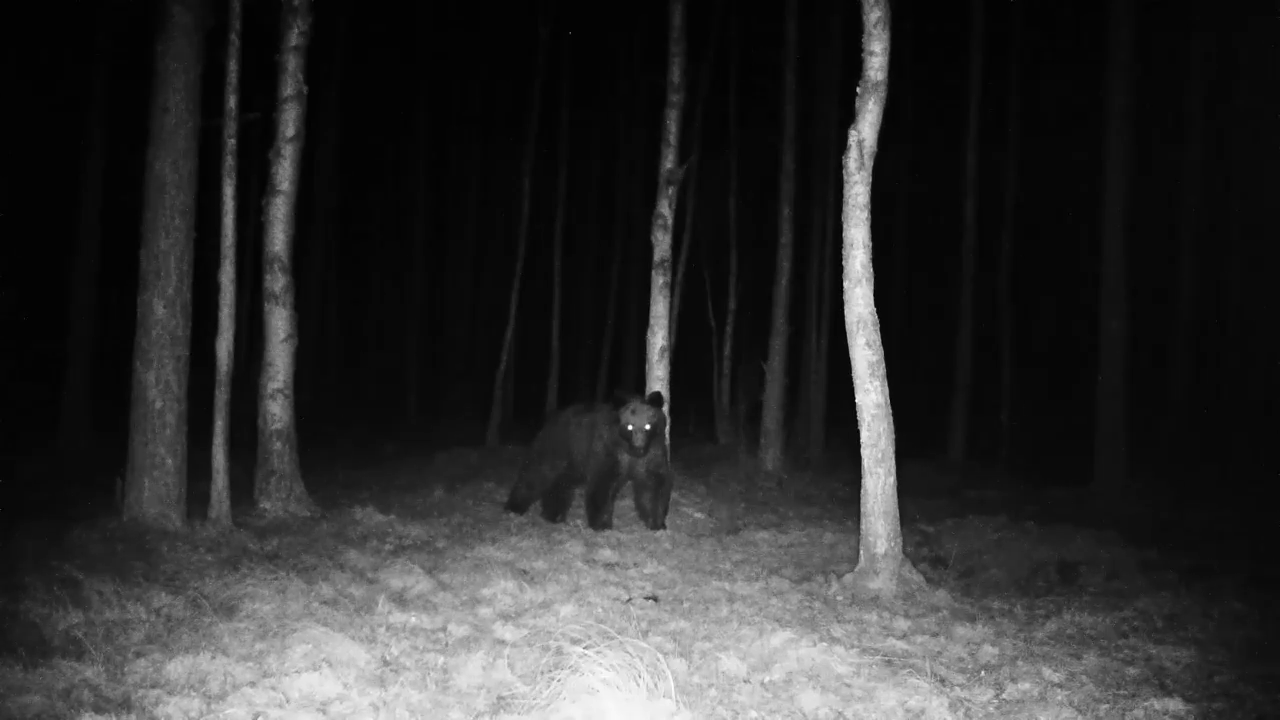
While it is perhaps too early to talk of a restored population — for that we will need evidence of a female with cubs — the future is nonetheless looking good for bears. The population in Naliboki Forest continues to expand, and further dispersers crossing the border seem only a matter of time. A new era in Europe’s last primeval forest may be just around the corner.
Update: Recolonisation of the Polish side has become considerably more difficult since the construction of the anti-migrant border wall between Poland and Belarus, completed in 2022. Whether bears — or any large mammal — can cross it will depend largely on the geopolitical situation calming down and any future modifications to the barrier. That said, in 2025 a bear was spotted on the Belarusian side of the forest by a forester, which suggests the animals are still present in the area and that long-term presence in Białowieża Forest remains a real possibility.
Are there bears in Białowieża Forest?
Not as a resident population, but bears have been recorded as visitors in recent years. A bear was filmed on camera trap in June 2019 — the first confirmed sighting since 1963 — and further sightings and tracks were recorded in 2020. These appear to be dispersing individuals from the expanding Belarusian population rather than established residents.
Where do the bears in Białowieża come from?
The most likely source is Naliboki Forest in Belarus, a large boreal wilderness near Minsk around 200 km from the Polish border. Bears have been expanding out of Belarusian refuges since the mid-2000s and dispersing individuals can cover that distance without difficulty.
Have bears ever lived in Białowieża Forest before?
Yes. Bears were historically present in the forest and hunted by Polish-Lithuanian kings. They were exterminated by the Russian administration in the 19th century, with the last individual killed in 1879. A reintroduction programme began in 1938 but was interrupted by the Second World War, and the last bears disappeared from the forest in 1947.
Are bears dangerous to humans?
Bears pose little direct danger to humans. Unprovoked attacks are extremely rare. They can, however, raid beehives, livestock and bins. If you encounter a bear, do not run — back away slowly, make yourself appear large, and speak calmly. Do not feed or approach bears under any circumstances.
Could bears permanently recolonise Białowieża Forest?
The outlook has become more uncertain since the construction of the anti-migrant border wall between Poland and Belarus, completed in 2022, which also blocks wildlife movement. Bears were still being recorded on the Belarusian side of the forest as recently as 2025, so the potential is there — but whether individuals can cross will depend on the geopolitical situation and any future changes to the barrier. A permanent population would also require at least one breeding female establishing a territory on the Polish side, which has not yet been recorded.
Go deeper
Explore the forest with an expert
Five days tracking wolves, finding bison and walking ancient old-growth — guided by a PhD ecologist.
Białowieża is Europe's last lowland old-growth forest, a place where rewilding isn't a project but a reality still in progress. Explore its ecology on our 5-day old-growth seminar and see what nature does when left to its own devices.
One Response