
Plants & Animals
Wolves in Białowieża Forest
The forest’s apex predator — ecology, behaviour and where their territories lie.
How are the wolves in Białowieża Forest, and where can they be found? These are the most common questions I get asked by visitors. The wolves here are among the best-studied in the world, making the answers lengthy but fascinating.
As elsewhere in Europe, wolves in Białowieża Forest have had a turbulent history. Over the past century their numbers have varied dramatically — peaking after wars, and crashing as extermination programmes were introduced. Particularly intensive persecution occurred between 1946 and 1960, at which point wolf numbers reached zero.
Fortunately, Białowieża Forest is connected to extensive wild forest in the east, and wolves recolonised spontaneously as the extermination programme wound down. Hunting was reduced to negligible levels by the 1980s, and wolves became strictly protected in 1989 — a status that continues to the present day.
Status in Belarus: Wolves across Poland’s eastern border are not afforded the same protection. Belarus operates a national wolf extermination programme targeting a population of around 500 individuals — compared to Poland’s total of roughly 2,000. Hunting even takes place within the Belałaveskaya National Park, the Belarusian counterpart to Białowieża. One of the few side-effects of the international border fence is that Polish wolves rarely cross into Belarus.
The Białowieża Forest wolf population
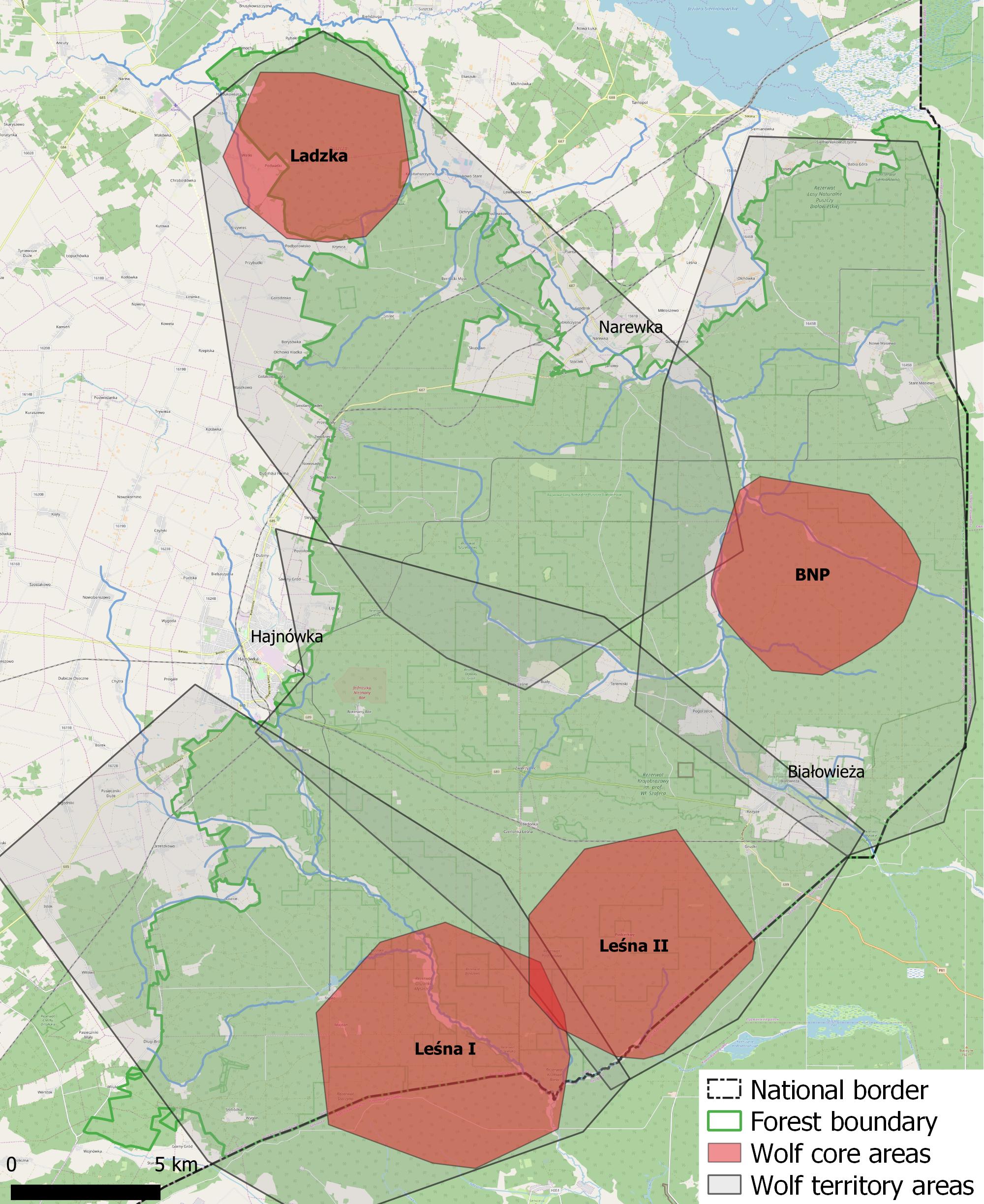
There are four wolf families (packs) in the Polish part of Białowieża Forest, though in recent years there have been reports of additional packs establishing territories. Systematic year-to-year monitoring no longer takes place, so the current picture is not entirely clear. Pack size varies depending on how many pups are born and how many survive, but packs generally number 5–10 wolves — giving a total Polish-side population of roughly 20–40 animals, possibly more.
This may seem small, but it appears to be close to the carrying capacity of the Polish section. Each family occupies around 200 km² and defends that territory from other wolves. The population has been remarkably stable: pack sizes and territory boundaries have remained broadly the same for over 20 years, even as the individual wolves within them have changed (wolves live up to 8–10 years in the wild).
Before this stable state emerged, an interesting event occurred. There used to be a single pack living in the south of the forest. That family split in two — which is why the two packs inhabiting the southern part of the forest, living side by side, are called the Leśna I and Leśna II packs. We have had four families ever since.
Diet and ecological effects
The diet of wolves in Białowieża Forest was studied extensively in the 1990s. A wolf family was found to kill prey on average once every couple of days. As elsewhere in Europe, red deer dominate the diet — comprising around 80% of biomass consumed. Roe deer and wild boar make up most of the remainder, with smaller mammals such as hares and beavers taken occasionally. Larger species like moose and bison are killed very rarely, though it does happen. Since those diet studies were conducted, wild boar have been virtually wiped out in the forest by African swine fever, so they likely play only a minor role in the contemporary wolf diet.
Wolf predation benefits the forest’s ecology in several ways. By taking a share of prey populations, wolves limit overgrazing of forest vegetation. They also tend to select weaker individuals, helping keep prey populations healthy. But perhaps most importantly, the mere presence of wolves triggers radical changes in prey behaviour — prey alter their movements and activity patterns to avoid predation. These so-called ‘landscape of fear’ effects are the focus of our research group, and a topic I’ll cover in more detail in a separate post.
Spatial distribution and activity patterns
A study from the 1990s tracked eight GPS-collared wolves to map how they used the forest in space and time. Four separate wolf families were identified, each occupying a distinct territory. Wolves were found to roam across the entire forest area, but to spend most of their time within a roughly 50 km² core area or rendezvous site — the centre of each pack’s activity, where they most often return to rest. These core areas are situated as far from human settlements as possible.
Wolf distributions were studied again more recently by a colleague of mine, Jakub Bubnicki, using an extensive camera trap network to map wolves, lynx and herbivores across the forest. His results confirmed that wolves still use broadly the same core areas as in the 1990s.
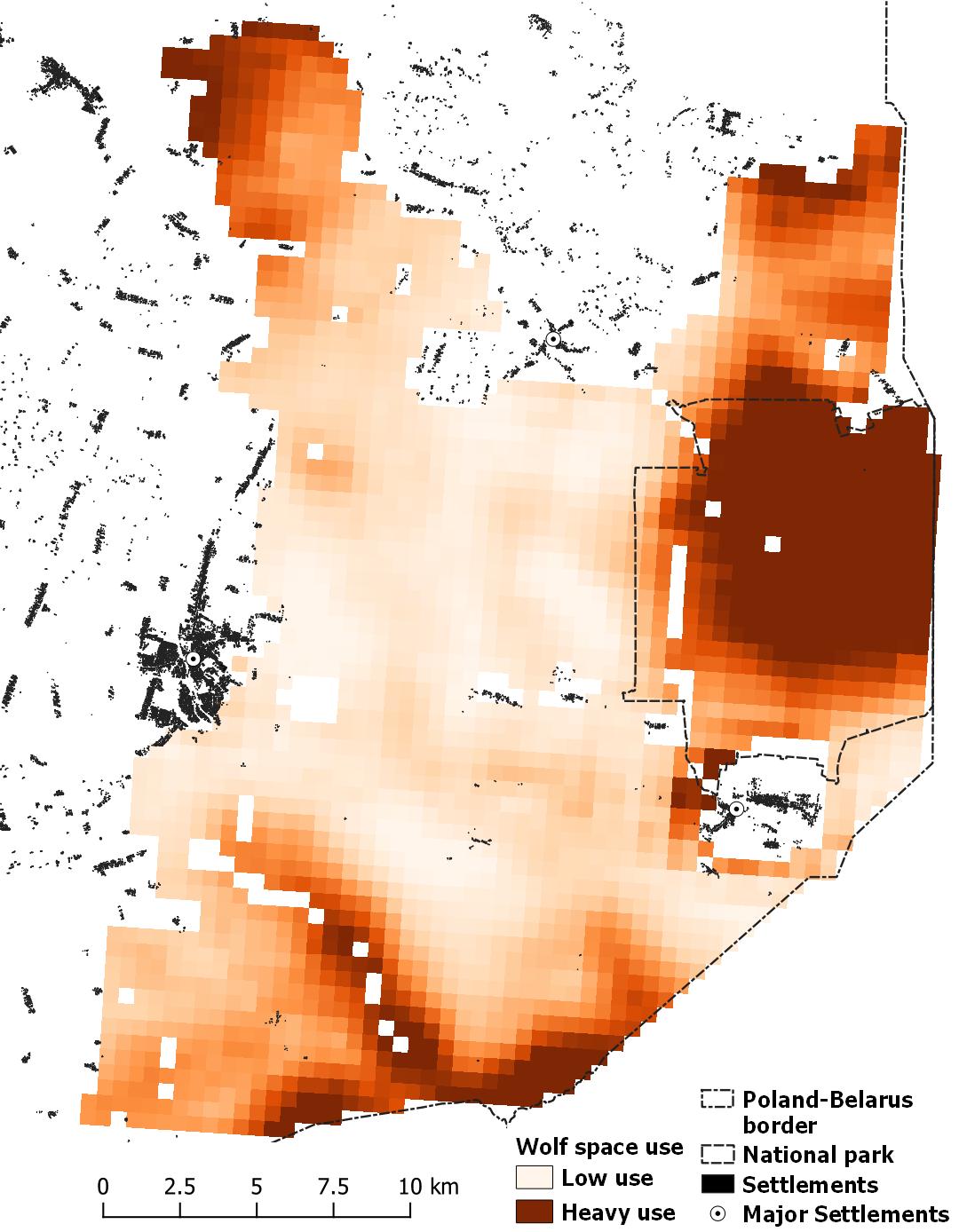
Wolves can be active at any hour, but their activity peaks at dawn and dusk — when prey are most active and hunting is most productive. Over the year they travel an average of around 25 km per day. In spring, during pup-rearing, they range less widely, staying close to dens and rendezvous sites. In autumn and winter they roam furthest, patrolling and defending their territories more intensively — a pattern that may also help prevent prey from becoming too accustomed to their presence in frequently used areas.
Spotting a wolf
For the best chance of a sighting, head towards the core areas around dawn or dusk. That said, wolves can turn up anywhere in the forest — even on meadows near the villages. Just bear in mind that direct sightings are rare: I see them only once or twice a year. You are far more likely to find field signs — tracks, scat, prey remains and territory markings — than the animals themselves.
Territory markings are most common in the core areas and along territory boundaries. Scat deposition is consistent throughout the year, but urine marking and ground scratching are 2–3 times more frequent between October and January.
Wolves generally pose no danger to humans. If you encounter one, remain calm, avoid sudden movements, and back away slowly. Wolves have relatively poor eyesight and may stare for a while trying to identify you before moving off.
Are there wolves in Białowieża Forest?
Yes. Białowieża Forest has hosted resident wolf packs for decades and is one of the best-studied wolf populations in Europe. Four packs currently occupy territories within the Polish section of the forest, with compositions tracked through camera trapping and GPS telemetry.
How many wolf packs are in Białowieża Forest?
Four packs have been the established figure for the Polish part of the forest, but there have been reports of additional packs forming in recent years. Systematic monitoring is no longer carried out year to year, so the exact current number is uncertain. Pack ranges can extend beyond the forest boundary into surrounding farmland and plantation forest.
Can you see wolves in Białowieża Forest?
Direct sightings are rare — wolves are secretive and actively avoid humans. However, Białowieża is one of the best places in Europe to find wolf field signs: tracks, scats, prey remains and territory markers. A guided trip with an experienced ecologist significantly improves your chances of finding fresh evidence.
What do wolves eat in Białowieża Forest?
Red deer are the primary prey, making up around 80% of biomass consumed. Roe deer make up most of the remainder. Wild boar were historically significant but have been largely wiped out by African swine fever. European bison are occasionally taken, usually calves or weakened individuals.
Are wolves dangerous to humans?
Wolves pose no meaningful danger to humans. Unprovoked attacks are extraordinarily rare across Europe. If you encounter a wolf, stay calm, do not run, and back away slowly. The wolf will almost certainly leave of its own accord.
Go deeper
Explore the forest with an expert
Five days tracking wolves, finding bison and walking ancient old-growth — guided by a PhD ecologist.
Discover wolf ecology firsthand on our guided old-growth seminar, five days exploring wolf territories, beaver meadows and ancient forest with a scientist who has studied this forest for nearly a decade.
Hello,
One morning of august 2020, my wife and i were walking the forest between the road Narewka-Bialowieska and the restricted zone when a wolf showed up 50m in front of us, crossing the path..
As he/she didn’t see us at first but could well smell us , he kept on making circles, about 50-100m away from us while sniffing constantly the ground.
We were standing motionless.
After about 1 minute like that, he headed straight towards us: 50m, then 30m, until he saw us.
At that stage, he got scared and ran away, tail between the legs.
He stopped suddenly as he was around 100m away, looked back at us a last time ( i could then take a photo through branches just in time) before desappearing for good.
So, yes, as you comment it here above, wolves have a very poor sighting.
Anyway, like probably to all those ones who ever saw the wolf in the wild, we are not about to forget that moment.
Even further, this made us feel like going back to Bialowieza next year!
All the best
Xavier en Inge
Hi, is it possible that the growing number of wolves may become a threat to domestic animals such as cattle, horses or even dogs? Do You have any information on the direction of movement of wolves toward the surrounding areas because of the growing number of them? According to my observations ( I’ve been regularly visiting Białowieża Primaeval Forest for 50 years, I;m a forester) the wolves there, are increasingly less afraid of people. Have You come to a similar conclusion? Can You share any information on the habitat of wolf packs roaming south of the Leśna river? Hope I’m not troubling You too much, with regards, George Barbarski.