
General Information
The Crazy Management System of Białowieża Forest
Why Europe’s last primeval forest isn’t fully protected — and how to make sense of the patchwork of zones.
Understanding Białowieża Forest’s crazy management system is essential for any visitor. One would expect a natural wonder like this to be protected in its entirety as a national park. However, this is not the case, and the forest is divided into management zones in a rather haphazard way. If you want to understand the root cause of the never-ending logging conflicts, or if you simply want to find your way around, then read on.
A Brief Historical Overview
Nowadays, parts of the forest are strictly protected, and parts are exploited for wood. It wasn’t always like this: for most of Poland’s history, the forest was strictly protected by royalty. Protection broke down during WW1, when the German occupying force began logging on an industrial scale.
Logging continues to this day, and only a small fragment in the national park has survived in a pristine state. Nevertheless, much of the rest of the forest remains in a fairly natural state and is teeming with biodiversity. Thankfully, since the fall of communism in 1989, increasing portions of the forest have become protected.
The Management Regime
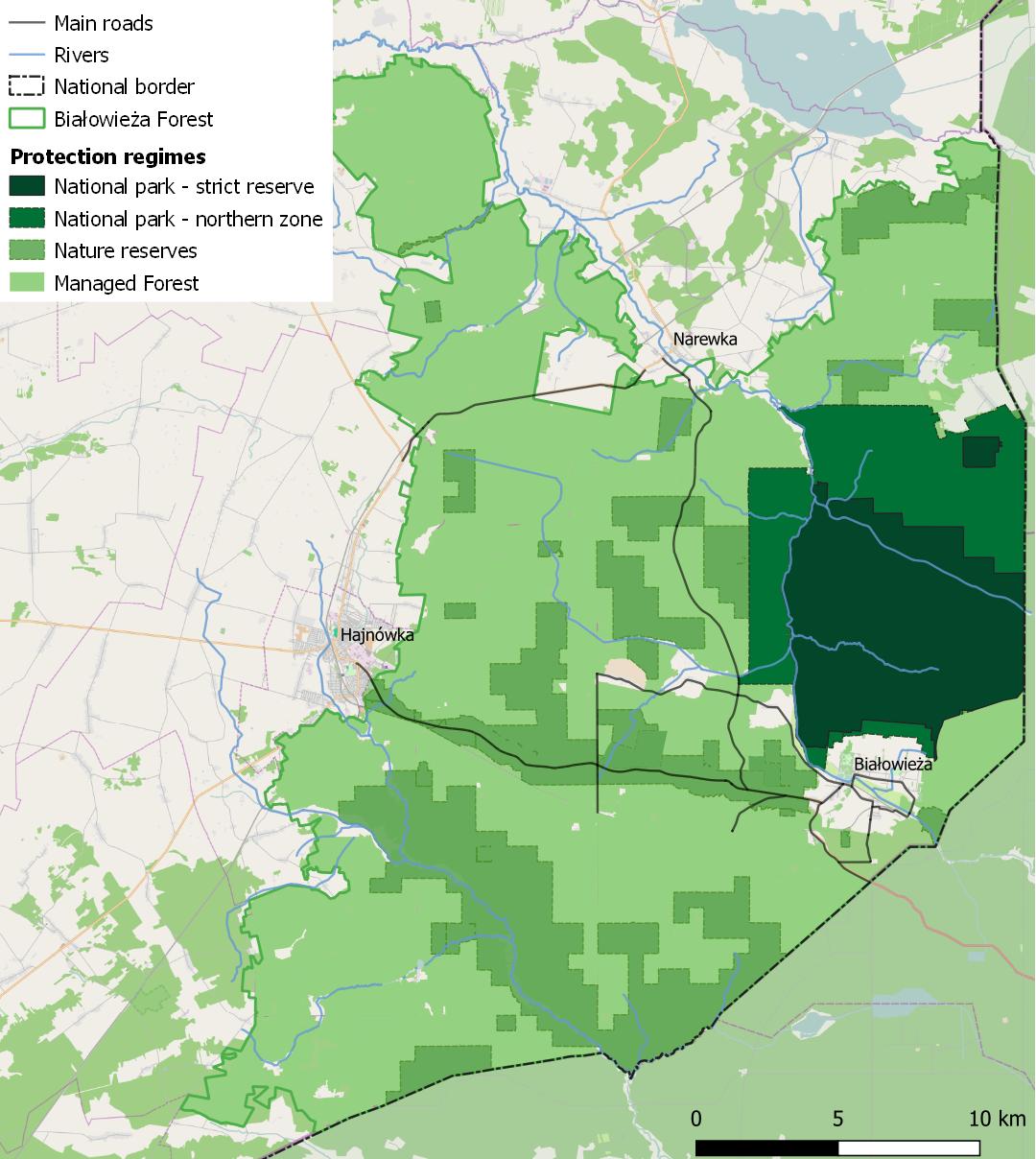
The forest is divided between nature conservation areas (one third of the area) and ‘managed’ forest (two thirds). The hundred-year-old strictly protected reserve of Białowieża National Park forms the pristine core of the forest — this area has never been logged and trees have never been planted here.
Various other parts of the forest are equally beautiful and little-touched by loggers. Over the past 30 years, protection has been extended to many of these areas, as a nature reserve network was established, and the national park was doubled in size. Despite this progress, the situation remains far from ideal. Many old-growth stands are still without effective legal protection.
A breakdown of the protection of the Polish side of the forest:
The national park covers 17% of the forest’s area. Half is protected as a strict reserve (closed to tourists without a guide) and the other half, the northern zone, is open to tourists.
Nature reserves strictly protect another 19%. These are open to the public, but you shouldn’t leave the trails.
‘Managed’ forest makes up the rest. The state forestry company manages this zone, subjecting it to low-intensity logging. This area is open to everyone.
International Obligations
The forest is encompassed by two more forms of protection originating from international treaty obligations. First, the entire forest is a Natura 2000 protected area, under the European Union’s Habitats and Birds Directives. This legally requires Poland to maintain all the forest’s habitats and species at ‘favourable conservation status’. Second, the whole forest is also protected as a UNESCO world heritage site.
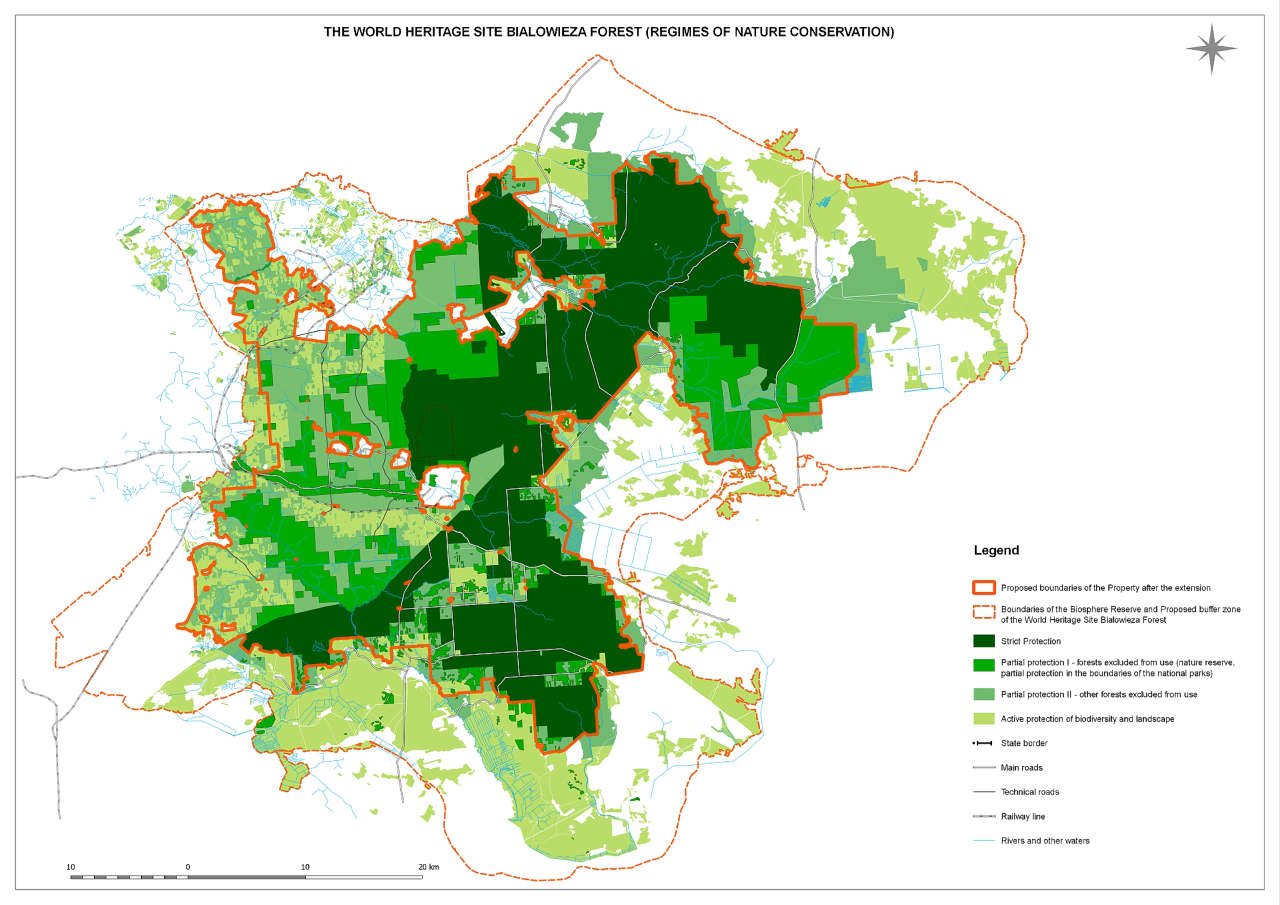
Since the fall of communism, successive Polish governments have failed to adequately protect this special forest. Although new protection regimes have been added — the enlarged national park, nature reserves, Natura 2000 site and UNESCO site — the forest is still inadequately protected.
History repeats itself every few years: foresters make a new logging plan, and despite environmentalists’ protests, the forest gets further degraded. The solution is to enlarge the national park to encompass the whole forest area. We can only hope that this will happen sooner rather than later.
Go deeper
Explore the forest with an expert
Five days tracking wolves, finding bison and walking ancient old-growth — guided by a PhD ecologist who has spent years studying Białowieża’s ecology.
View the tour →The tension between forestry and conservation in Białowieża is one of Europe's most instructive conservation battles. Explore its legacy in the landscape on our 5-day old-growth seminar, walking both ancient stands and areas now rewilding after the chainsaws fell silent.
One Response