
General Information
Where Are the Best-Preserved Parts of the Forest?
How to find old-growth forest in a landscape transformed by a century of logging.
The past century of logging has transformed Białowieża Primeval Forest into a mosaic of natural and plantation forest. Fortunately there’s still plenty of natural (old-growth) forest to see, but to find it, you need to know where to go.
History
Only a century ago, Białowieża Forest was in its entirety a near-pristine wilderness that had been protected for centuries. Everything changed during WW1. The German occupying force began intensive logging in what became the most destructive period in the forest’s history. In just three years, a quarter of the forest’s area was devastatingly cut and carted away.
Since then, logging has continued at varying intensities. Thankfully, large areas of primeval forest have survived, including one very special place — the strict reserve of the national park, which covers 8% of the Polish side of the forest. Earmarked for special protection as far back as WW1, this small fragment is the only part of the forest that has survived in a pristine state.
The rest of the Polish side has been logged to varying degrees. But don’t let that dishearten you: there’s still plenty of natural forest to be seen. In recent years, the best-preserved areas outside the strict reserve have been given protected status. These protected areas are where you should aim to visit.
Where to Find the Best-Preserved Forest
There is a simple rule of thumb: look for the protected areas — the nature reserves and national park. Whatever you do, don’t just head off in a random direction, as you can end up cycling through endless pine plantations.
Particularly stunning fragments of natural forest have survived in the north of the national park, in the centre of the forest around the three small villages of Pogorzelce, Teremiski and Budy, and in the far south on the Belarusian border.
In the map below, I’ve divided the forest into three zones. Head towards Zone I (darkest green) and Zone II (dark green) — this is where the best-preserved bits are.
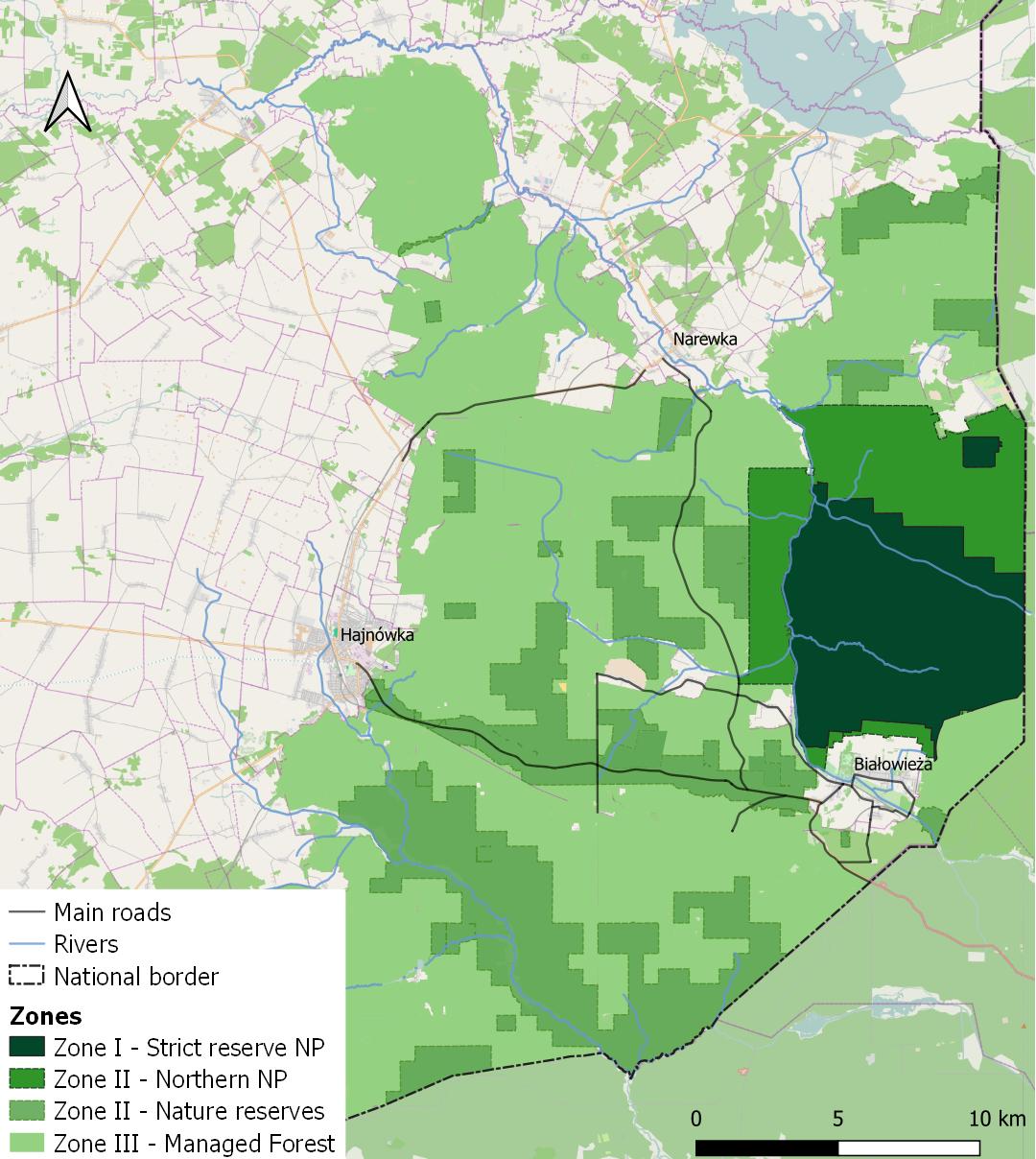
The Zones
Zone I — The national park’s strict reserve, the pinnacle of European forests. It is wild, untouched, and ancient. It requires a guide to visit, but it’s the only pristine part of the forest, so don’t miss it.
Zone II — The north of the national park and nature reserves. These areas have been subject to some logging over the past century, but have retained their natural character.
Zone III — The managed forest. Although there is plenty of old-growth forest here, it can be dispersed and harder to find.
Find a Good Map
A further trick for easily finding the wild places is getting a good map. In addition to showing you where the protected areas are, a good map will show you the ages of all the forest sub-divisions. Usually, the older the forest stand, the more natural it is.
This is handy, because there is a rather simple definition for old-growth forest in Białowieża Forest: tree stands over a hundred years old are of natural origin. Why a hundred years? Because that’s when logging began here (during WW1). Anything older than that is of natural origin.
The rule of thumb: Head to the nature reserves and national park (Zones I & II).
Go deeper
Explore the forest with an expert
Five days tracking wolves, finding bison and walking ancient old-growth — guided by a PhD ecologist who has spent years studying Białowieża’s ecology.
View the tour →The best-preserved fragments of Białowieża's old-growth are extraordinary, and knowing what to look for makes all the difference. Our 5-day old-growth seminar takes you into these ancient stands with a scientist who can read what the forest is telling you.
6 responses