
Area Guide
The Wild Southeast
Remote, wild and well-preserved — ancient forests along the Belarusian border.
The southeast of Białowieża Forest is a remote and wild place. With no public roads and sparse tourist infrastructure, you can easily go a whole day without seeing another person. Large parts of southern Białowieża Forest have escaped the forester’s axe, meaning the forest in the south is, for the most part, remarkably well-preserved.
To get to the interesting parts, you’ll need to cycle south-westwards from Białowieża Village. You’ll have to put up with drab plantation forests for the first half hour or so, but I assure you, it’s well worth it. The forest becomes more natural the further south you go.
Mode of Transport
I recommend cycling. There are no roads open to cars down here and walking won’t get you far, as the distances are too large.
How to Get Here
Generally, for any trip into the southern parts of the forest, you’ll want to cycle out of the village along Jagielloński Tryb. If you have a car to transport your bikes, you can park at ‘Miejsce Mocy’ and cycle southwards from there.
Trips
There are a couple of marked trails and lots of assorted forest tracks to choose from. I recommend two alternative trips — one that follows the marked yellow cycle trail between Białowieża and Topiło, and another that explores unmarked forest tracks through some of the most scenic nature reserves. As with other parts of Białowieża Forest, stick to the nature reserves if you want to see primeval forest.
1a: Olemburski Circuit
| Time | Distance | Mode | Difficulty |
|---|---|---|---|
| 3–4 h | 20 km | 🚲 Cycle | Easy |
📍 Tracks: Jagielloński, Pacowski, Olemburski Tracks, then return via Sinnicka droga.
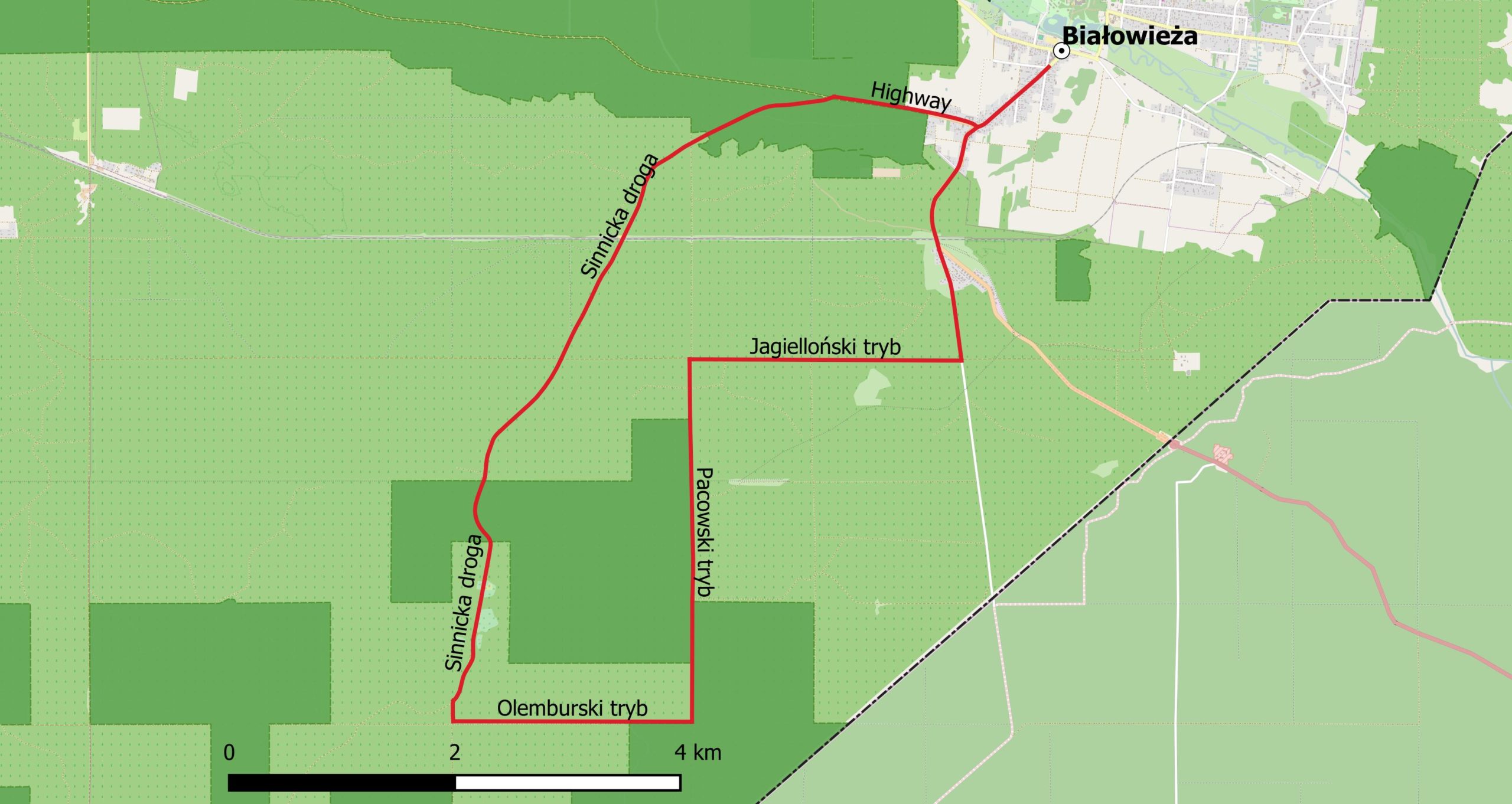
This is the shortest route option. Travelling southwards along Pacowski Tryb will gradually take you out of plantations into primeval forest. As you travel south, the forest on either side will get wetter. The old-growth deciduous forest will gradually morph into a sodden alder bog forest. Look out for the prehistoric looking horsetails that grow here in spring.
Turn right onto Olemburski Tryb, where you’ll emerge into one of my favourite alderwoods. On the left is a classic alderwood, and on the right — a transformed habitat — a wide-open landscape covered in dead standing trees, myriad colourful flowers, and various water-loving species. I’ve spotted the black stork feeding here several times.
1b: Kozłowa Tropina Circuit
| Time | Distance | Mode | Difficulty |
|---|---|---|---|
| 3–4 h | 22 km | 🚲 Cycle | Medium |
📍 Tracks: Jagielloński, Pacowski, Kozłowa Tropina, then return via Kozłowy and Sinnicka tracks.
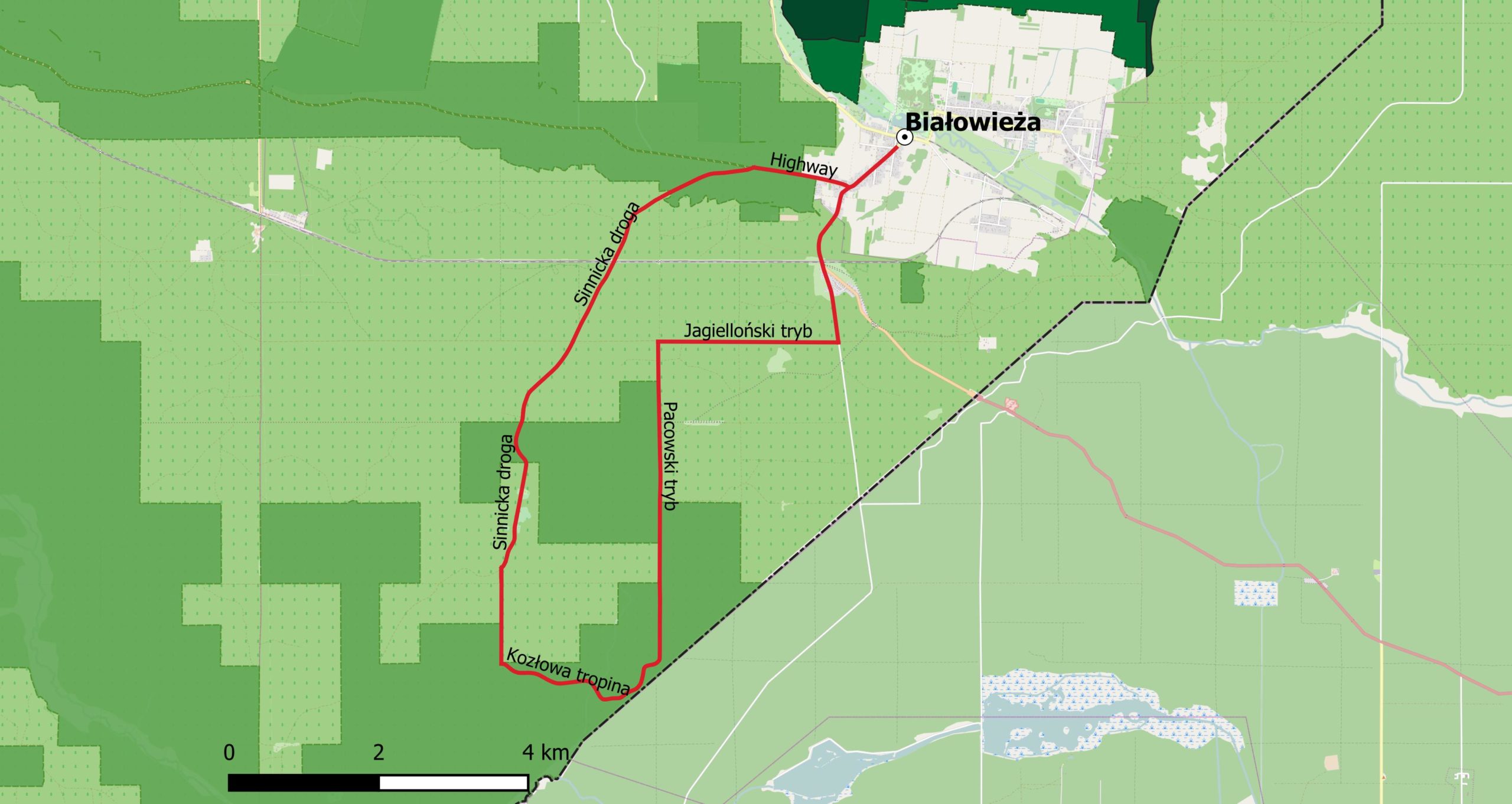
For the most part, this route is the same as the previous, except it adds the short spur of Kozłowa Tropina — one of Białowieża Forest’s finest sights. It’s a bumpy, hard ride for 3 km, but it’s well worth it. Be sure to stop on the bridge over the Podcerkówka.
1c: Kurdzimowski Circuit
| Time | Distance | Mode | Difficulty |
|---|---|---|---|
| 5–6 h | 30 km | 🚲 Cycle | Medium/Hard |
📍 Tracks: Jagielloński, Pacowski and Kozłowa Tropina tracks, then south onto Kozłowy tryb, west along Kurdzimowski Tryb and back via Sinnicka droga.
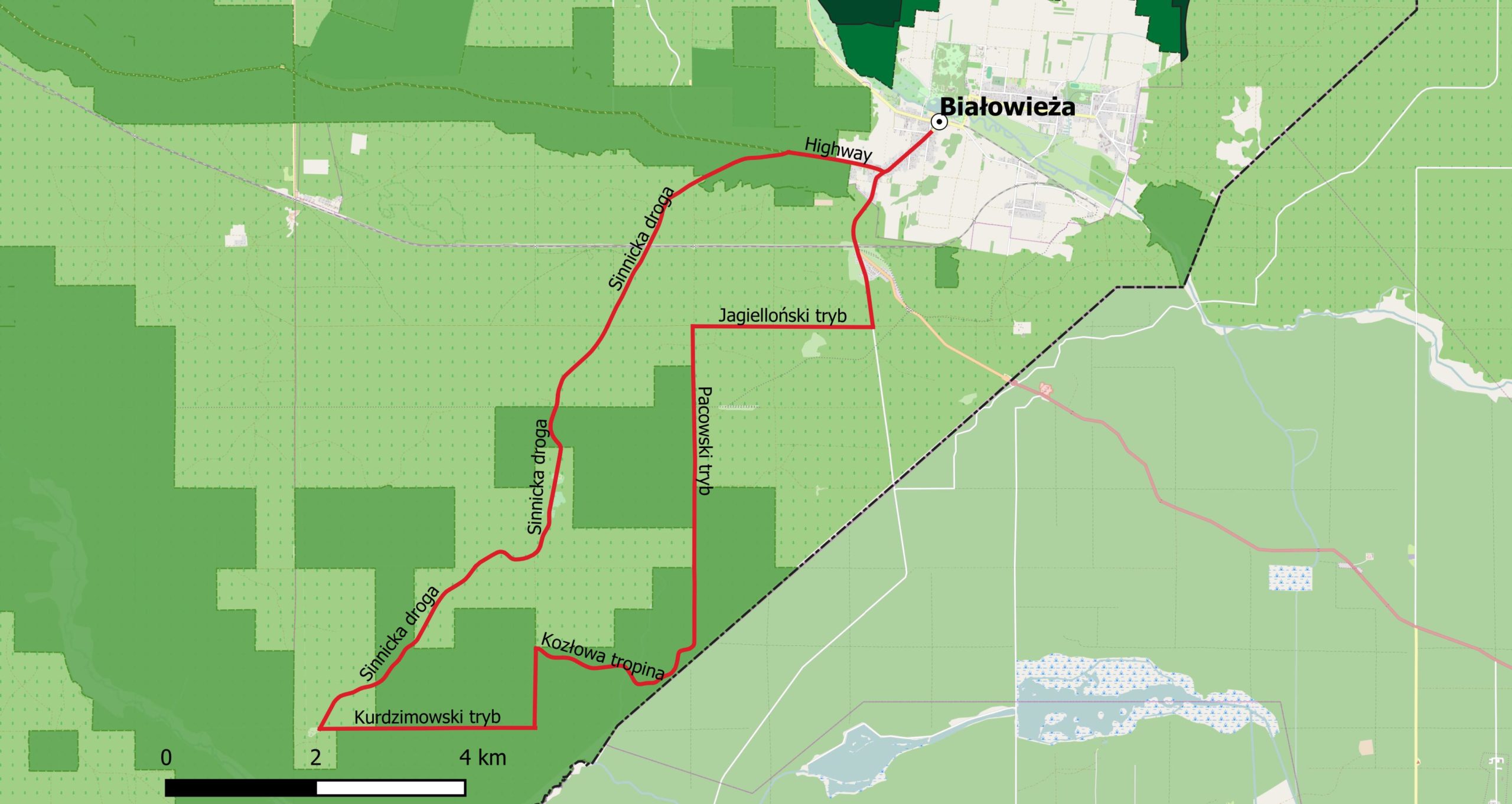
This whole day option will take you through the whole gamut of south Białowieża Forest’s wild nature reserves. It also gives you the option of going off-piste into the Kozłowe Borki or Przewłoka nature reserves. Bear in mind that the track surface becomes hard work south of Olemburski. But don’t be too put off — the way home along Sinnicka Droga is easy, along possibly the best surfaced forest track there is.
2: Topiło Day Trip
| Time | Distance | Mode | Difficulty |
|---|---|---|---|
| 5–6 h | 40 km | 🚲 Cycle | Medium |
📍 Tracks: Highway, Sinnicka droga, Olemburski track.
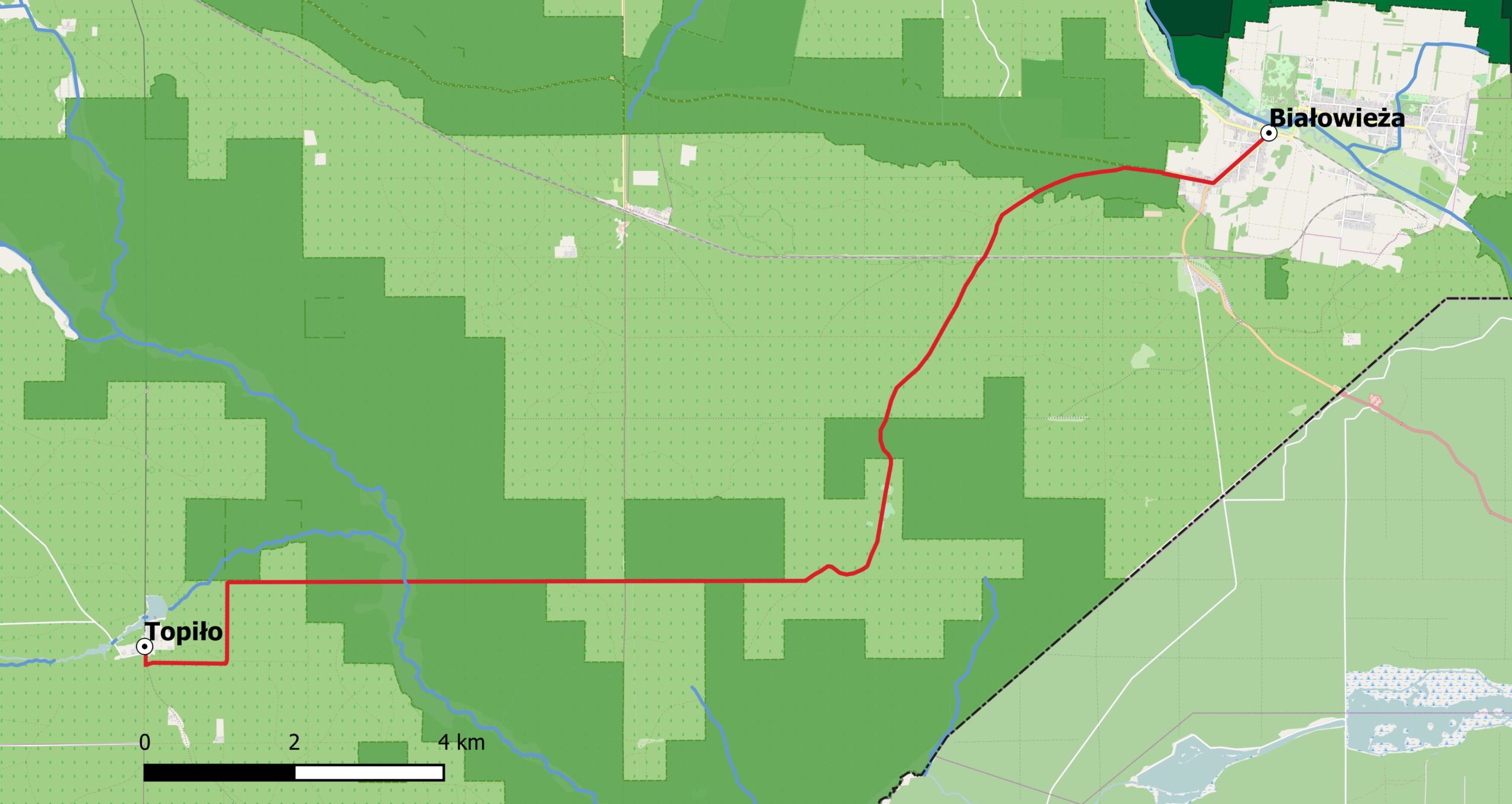
Another nice day trip heading south-west through the forest to the hamlet of Topiło. The tracks are wide, flat and well-surfaced for the whole length. You’ll cycle through a variety of landscapes — from managed monocultures, through dark deciduous forests, through the ancient primeval swamps of Berezowo, and onto the wild Leśna river valley (the only un-canalised river in Białowieża Forest).
A couple of kilometres after the river, you’ll be rewarded with the only open water body in the forest — Topiło lake next to Topiło, a small hamlet with shop and bar (open in summer). The only downside is that you have to return on the same route.
Forest Track Descriptions
Jagielloński Tryb — The main east-west track in the north. Very easily cyclable but not beautiful. The forest has been heavily transformed on either side — vast spruce monocultures planted after WW2, much of which is now dead or dying from bark beetle. Nature rating: 1.
Sinnicka droga — One of the main southbound tracks. Links up all the other tracks. Wide and well-surfaced, making for easy cycling. Nature rating: 2–3.
Bagienny Tryb — Goes south from Jagielloński. Gradually emerges into wonderful primeval bog forests, particularly the final kilometre through some of the finest alderwoods I’ve ever seen. Poor surface after heavy rains. Nature rating: 3.
Pacowski Tryb — Also goes south from Jagielloński. More variety of forest types than Bagienny. Begins with pine plantation, emerges into natural bog forest. Nature rating: 3.
Olemburski Tryb — The main east-west track spanning the middle-south. Wonderful swamps on either side. Nature rating: 4 (around the flooded forest and Berezowo nature reserve).
Kozłowa Tropina — One of the most amazing, wild roads. Showcases all of what the forest is about. A 3 km stretch through the heart of a nature reserve. Hard to cycle, but worth it. Nature rating: 5.
Kozłowy Tryb — A short north-south connector. Not interesting in itself but links all the best parts of south Białowieża. Nature rating: 2.
Kurdzimowski Tryb — Spans the south east-west. Wild and little explored at the eastern end. Nature rating: 3.
⚠️ Not worth visiting: Zwierzyniecki Tryb — the main north-south track in the centre. The forest on either side has been transformed into plantations. Nature rating: 1.
There is nothing to do here other than explore nature.
The wild southeast is one of the least-visited corners of Białowieża, and one of the most rewarding. We explore areas like this on our 5-day old-growth seminar, away from the tourist trails and into the real forest.
One Response