
Plants & Animals
Which trees grow here?
Identifying the forest types you’re walking through — from lime-hornbeam to bog alder.
As you pass through the ancient woods, take care to note how the scene changes: even a short walk can take you through several different forest types. Europe has transformed most forests to maximise their profitability — draining soils, felling ancient trees, and replacing them with monocultures of fast-growing conifers. Białowieża has preserved its natural landscape diversity. Wet, leafy and coniferous woodlands are all here, sometimes within a few hundred metres of each other.
What is old-growth?
You’ll need to head to the old-growth stands to see Białowieża’s tree communities in all their majesty. Old trees and dead trees are the hallmarks of old-growth forest. In most managed forests, trees — often of a single species, planted in rows — are cut down as they reach 80–100 years. Any that die naturally are removed, stripping dead wood from the ecosystem. In an old-growth forest, by contrast, you can see trees at every stage of their lifecycle: seedlings, middle-agers, veterans and decomposers.
In natural forests, trees grow spontaneously and chaotically. Without the forester’s saw, they grow past middle age — sometimes reaching 300 years, with some oaks pushing 500. When their time comes, they die a natural death, often standing as a snag for several years before falling to the ground. In this climate zone, a tree can spend 25% of its lifespan decomposing, providing habitat for myriad dead-wood-dependent species: woodpeckers, saproxylic beetles, fungi. The critical difference between natural and managed forests is that the whole cycle of life and death happens without human intervention.
Windthrows — trees uprooted by storms — are a regular feature of old-growth forest. Note their spectacular root plates; birds are known to nest in the cavities of upturned roots.
The three tree communities
Bear in mind that the same forest type can look quite different in different parts of the forest. Silviculture has homogenised large areas into plantations; bark beetle outbreaks have killed most trees in some stands; and local variation in soil and water conditions produces natural variation in tree composition and structure. Each community type also has several subtypes that can differ from one another quite markedly.
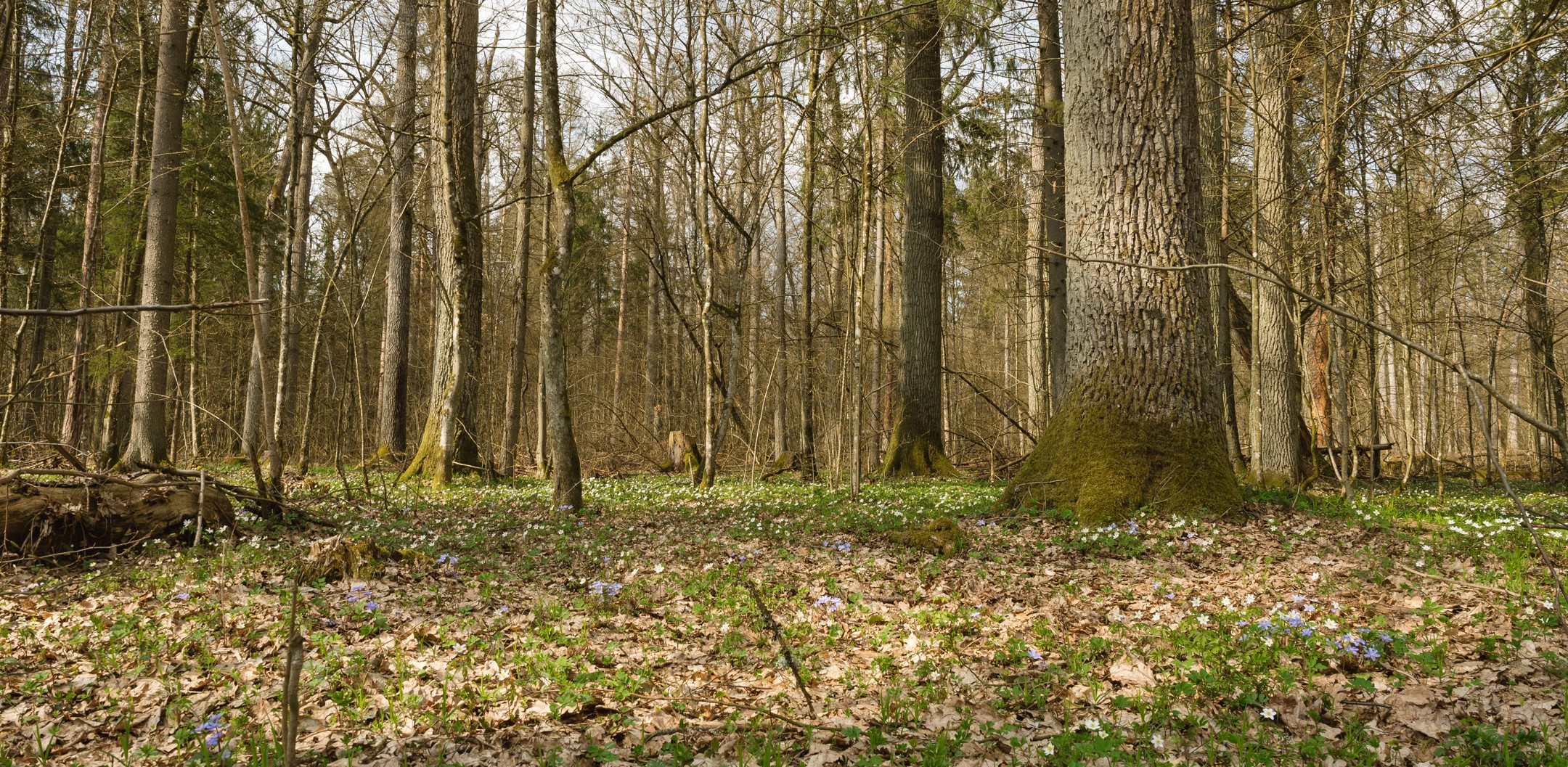
1. Deciduous (oak-lime-hornbeam) forest
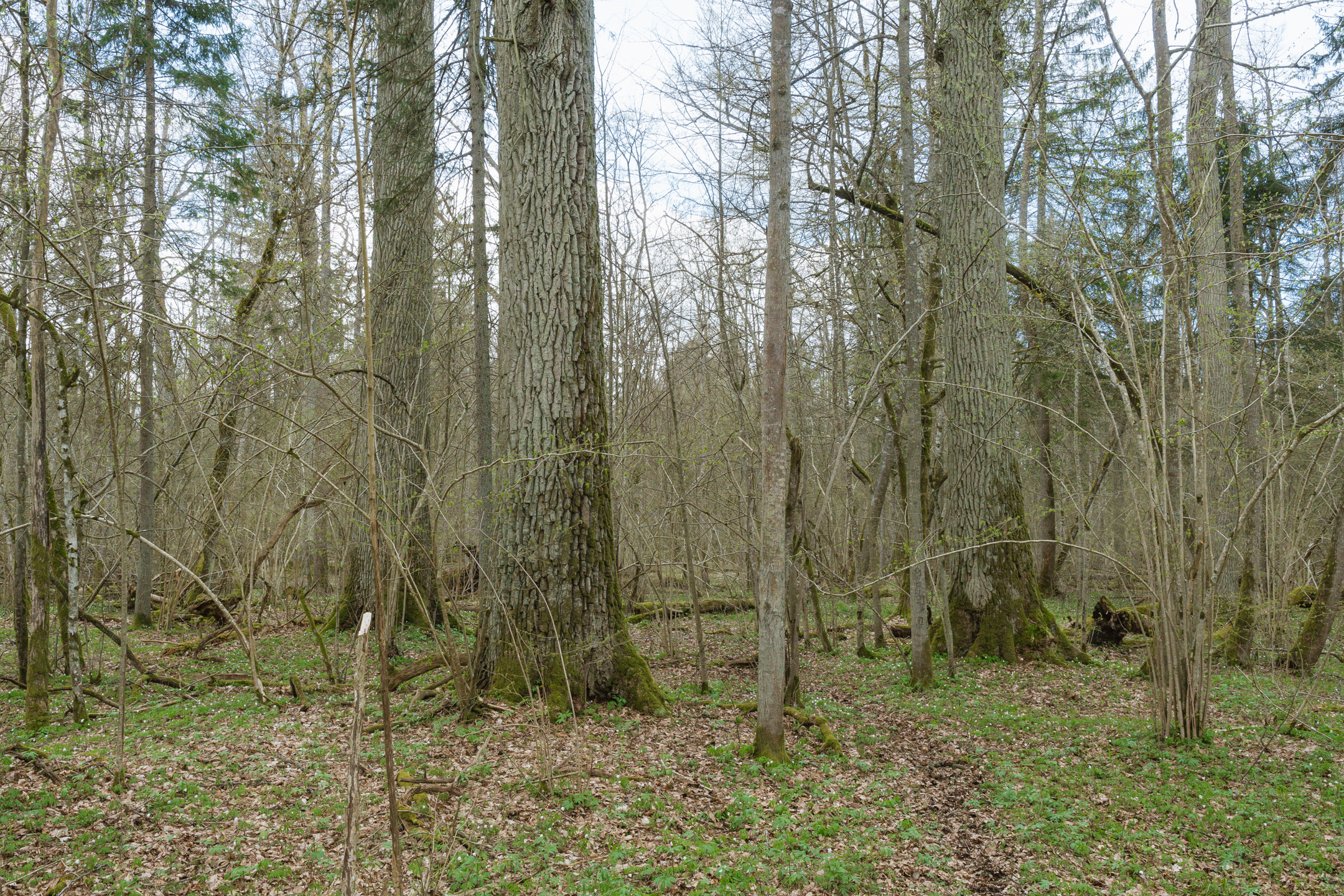
This is Białowieża’s most iconic forest type — a mix of oak, lime, hornbeam and maple, with the occasional pine or spruce. It is particularly beautiful in spring, when the forest floor is carpeted in flowers, and in autumn, when the trees are draped in gold. This community dominates the strict reserve, where it can be seen in its most pristine form.
Deciduous woods cover 50% of the Polish side of the forest — exceptional by European standards. Leafy trees prefer fertile soils, which across Europe were long ago cleared for farmland. That’s why most European forests are largely coniferous. Białowieża’s deciduous woods survived only because of the forest’s centuries-long protection.
In the better-preserved stands, look for the ancient trees. Oaks can reach 500 years and attain trunks of 6 m in circumference — the most impressive feature of these woods. Lime, maple and hornbeam can reach 300 years, ages rarely attained elsewhere. And look out for old hornbeams in particular: possibly the goofiest-looking trees in existence.
Several deciduous species here practice masting — producing few seeds for several years running, then mass-producing fruit in a single bonanza year, every 5–7 years. The aim is to temporarily overwhelm seed predators (rodents, wild boar, mice) so that some offspring survive. These pulses of seed production are a powerful ecosystem process, driving population cycles all the way up the food chain to owls and weasels.
2. Coniferous forest
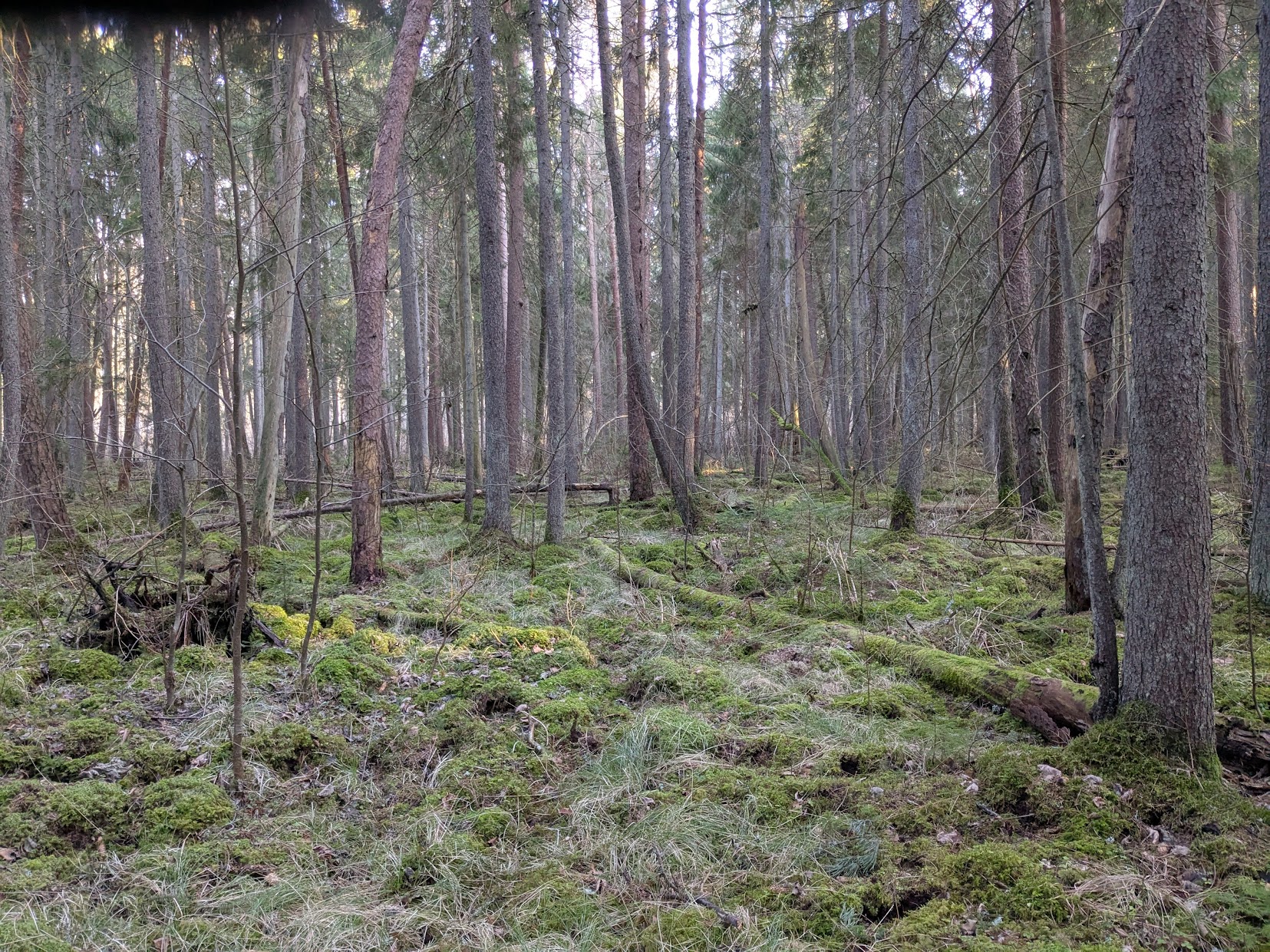
Coniferous forest is dominated by pine and spruce, with various deciduous species mixed in. The forest floor is usually sparse — mostly carpeted in thick moss, bilberry and moor grass. Much of the coniferous stand in the managed forest is anthropogenic, planted by foresters over the past century. Some natural coniferous forest also grows in the strict reserve, though in areas inaccessible to tourists.
Spruce-dominated forest is particularly atmospheric — intensely green year-round and very dark beneath. In recent years, a massive bark beetle outbreak has ravaged Białowieża’s spruce. The beetle drills into bark, lays eggs, and the larvae gorge on the tree’s soft tissue. If the tree fails to defend itself, it dies — and millions have. The stark, cemetery-like landscapes where these magical forests once stood are impossible to miss.
Spruce once covered around 25% of the Polish side of the forest; foresters estimate half of those trees are now dead. Some stands have survived and the species is regenerating in certain areas, but climate change is making conditions broadly unfavourable for spruce. It seems likely the coming decades will see it retreat to only its most suitable habitats within the forest.
3. Bog forests
Bog forests technically comprise many different subtypes, but they share a common character: moisture. Usually dominated by ash and alder — in rarer cases by spruce, birch or pine — they grow along watercourses, river valleys and depressions. Even when there is no standing water on the surface, the ground is usually sodden underfoot. These communities are increasingly drying out due to climate change and historical drainage works.
In many bog forests you can see a characteristic mosaic of hollows and hummocks. Trees grow on the raised hummocks, their root systems giving them their structure. The forest floor is usually covered in ferns, nettles and moss. The most otherworldly plants are the horsetails — species that look transplanted from the distant past. They are.
Drainage works have endangered this forest type across Europe, where wetlands have traditionally been dismissed as ‘wasted’ land. In Białowieża, bog forests were largely inaccessible to foresters, which saved them from the saw and preserved their natural character. But even here, groundwater levels are falling fast. As bog forests dry, deciduous forest is encroaching into areas previously too wet to support it.
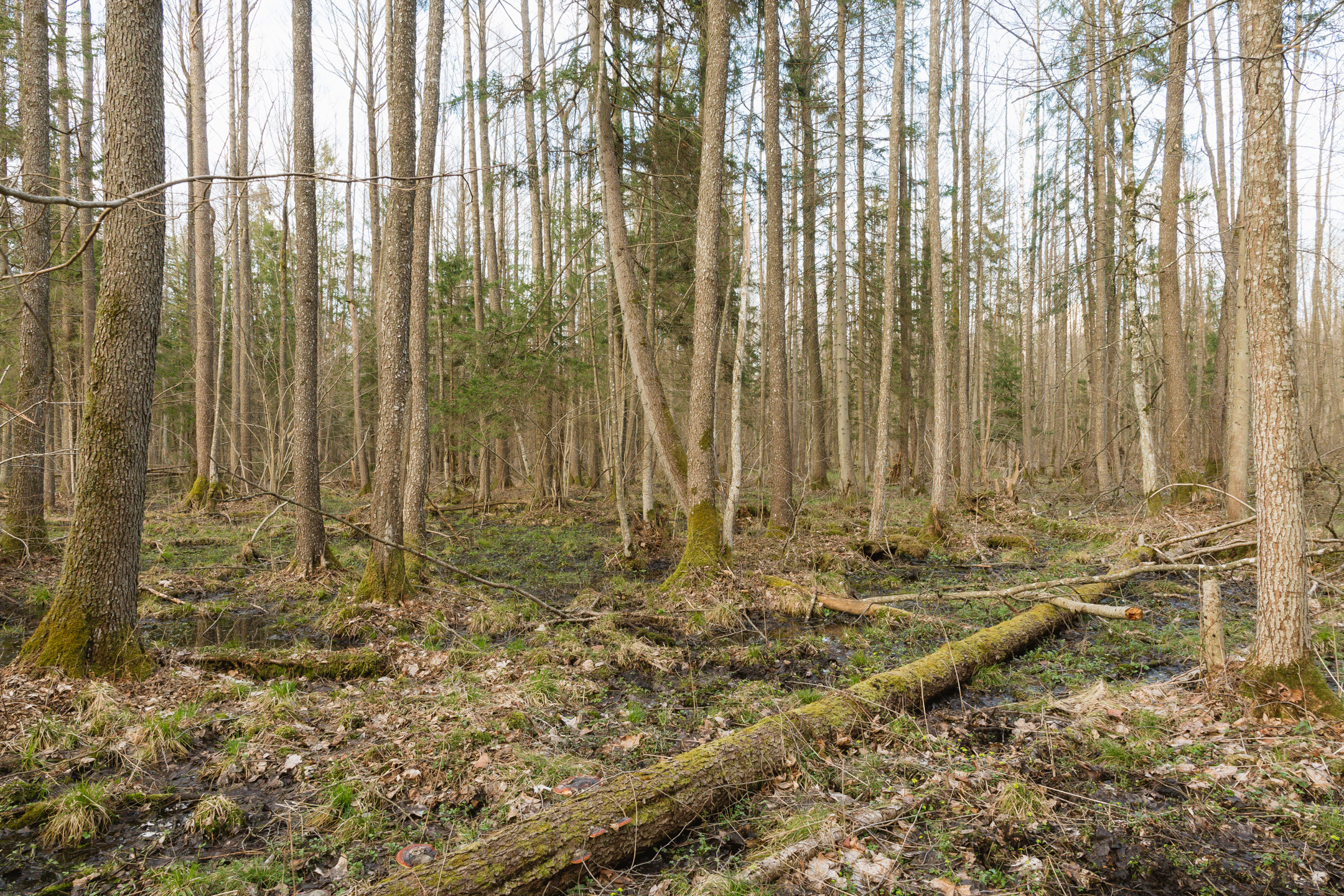
Enjoy the bog forests while you still can. They’re like a time machine into an age before humans transformed the land — a portal into something resembling the coal forests of 300 million years ago.
What types of forest grow in Białowieża?
Three main types: deciduous oak-lime-hornbeam forest, coniferous pine and spruce forest, and bog forests dominated by alder and ash. The deciduous forest is the most iconic and covers around 50% of the Polish side — exceptional by European standards.
What is old-growth forest?
Old-growth forest is woodland that has never been significantly disturbed by human management. It is characterised by trees of all ages — including very old specimens and large amounts of dead wood in various stages of decay — and by the complex ecological communities that depend on them. The best-preserved old-growth in Białowieża is found in the strict reserve and nature reserves.
Why are so many spruce trees dead in Białowieża?
A bark beetle outbreak — the European spruce bark beetle — has killed a large proportion of Białowieża’s spruce trees over the past decade. This was the subject of a major political controversy in 2017 when the Polish government authorised large-scale logging under the pretext of controlling the outbreak. The scientific consensus is that the outbreak was driven primarily by climate stress and that logging did not control it. See the 2017 logging conflict article for more.
Where can I see the best old-growth forest?
The strict reserve is the most pristine area, but requires a licensed guide. The best-preserved parts of the wider forest are found in the nature reserves scattered across the Polish side — these are accessible independently.
Go deeper
Explore the forest with an expert
Five days tracking wolves, finding bison and walking ancient old-growth — guided by a PhD ecologist.
Białowieża's old-growth forest is a living lesson in what European woodland can look like without human management. Explore its different forest types in depth on our 5-day old-growth seminar, understanding what makes ancient trees, dead wood and natural regeneration so ecologically vital.
2 responses