
Wolves & Ecology
The Ecological Impact of Wolf Reintroduction to Britain
What research from Białowieża Primeval Forest tells us about what to expect if wolves return to Scotland — by a wolf ecologist who works here.

A wolf at the edge of Białowieża village in winter
Wolf reintroduction to Britain is again a hot topic in the media. So I want to share what we know about the wolf’s ecological impacts in a model European system — Białowieża Primeval Forest — and what that knowledge might mean for the Scottish Highlands.
I’m based in Białowieża and recently submitted my PhD thesis on wolf ecology. My colleagues at the Mammal Research Institute PAS have been studying wolves here for three decades and have perhaps published more original research on wolf ecology than any other team in Europe. You can find my publications here.
Białowieża Primeval Forest, as the best-preserved lowland woodland in temperate Europe, serves as a reference system for forests elsewhere on the continent. Studies here can help reveal what ecological interactions may manifest as species recolonise or are reintroduced elsewhere. If you want to know more about why this forest is special, see this paper.
One caveat before we begin: large carnivore impacts are context dependent. What manifests in one system may not appear in another. With that said, the knowledge from Białowieża does give genuine insight into what you might expect should wolves return to Scotland.
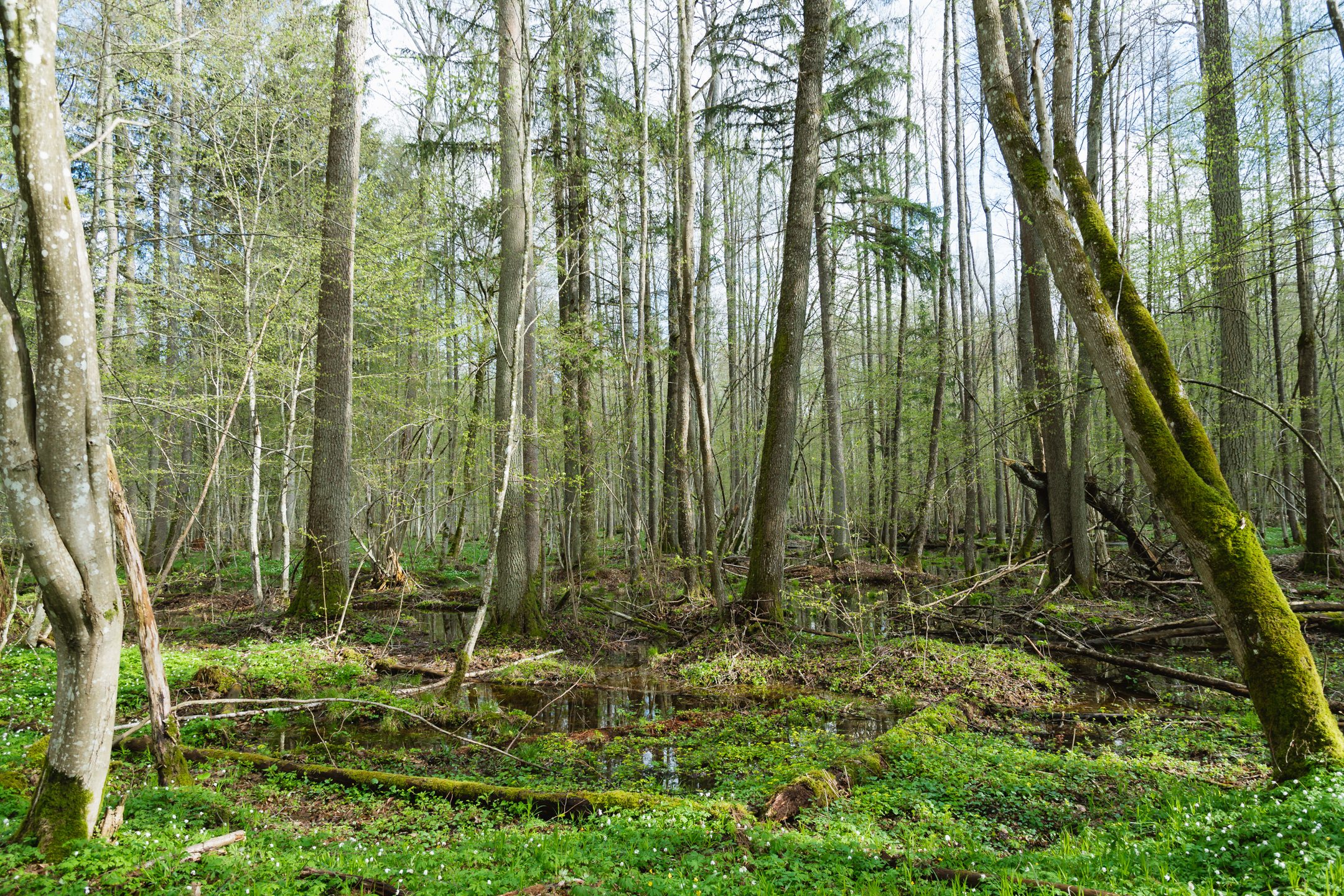
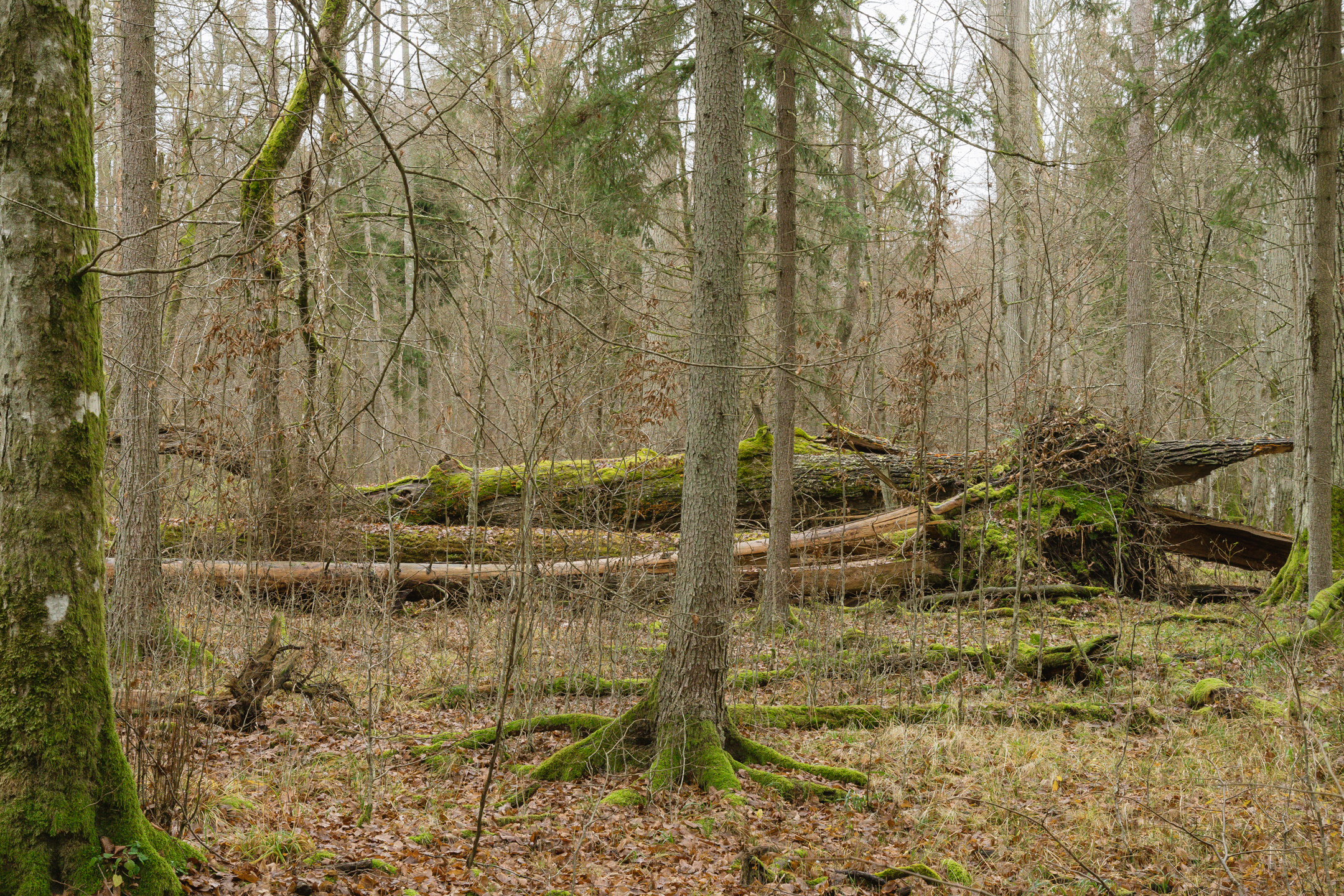
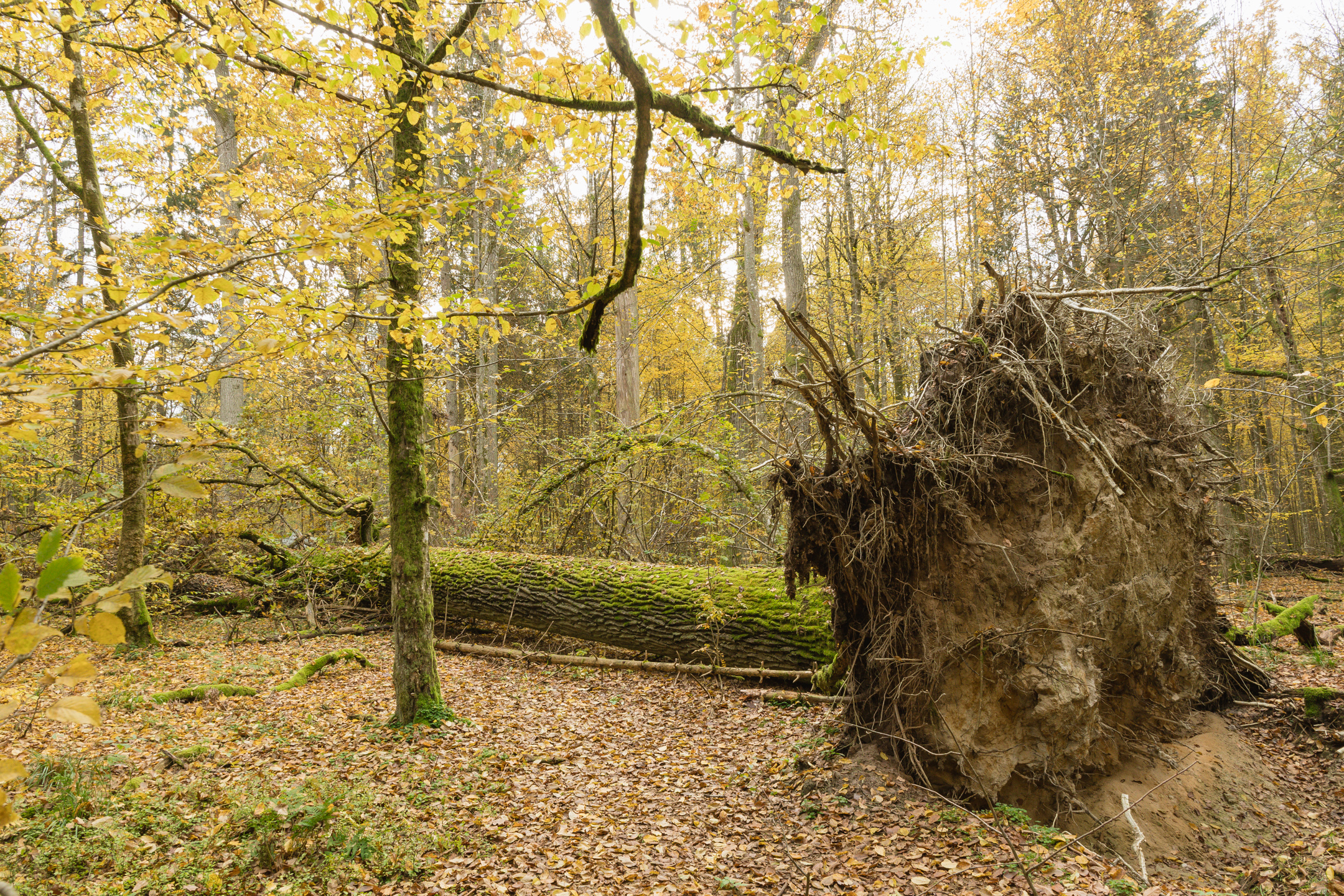
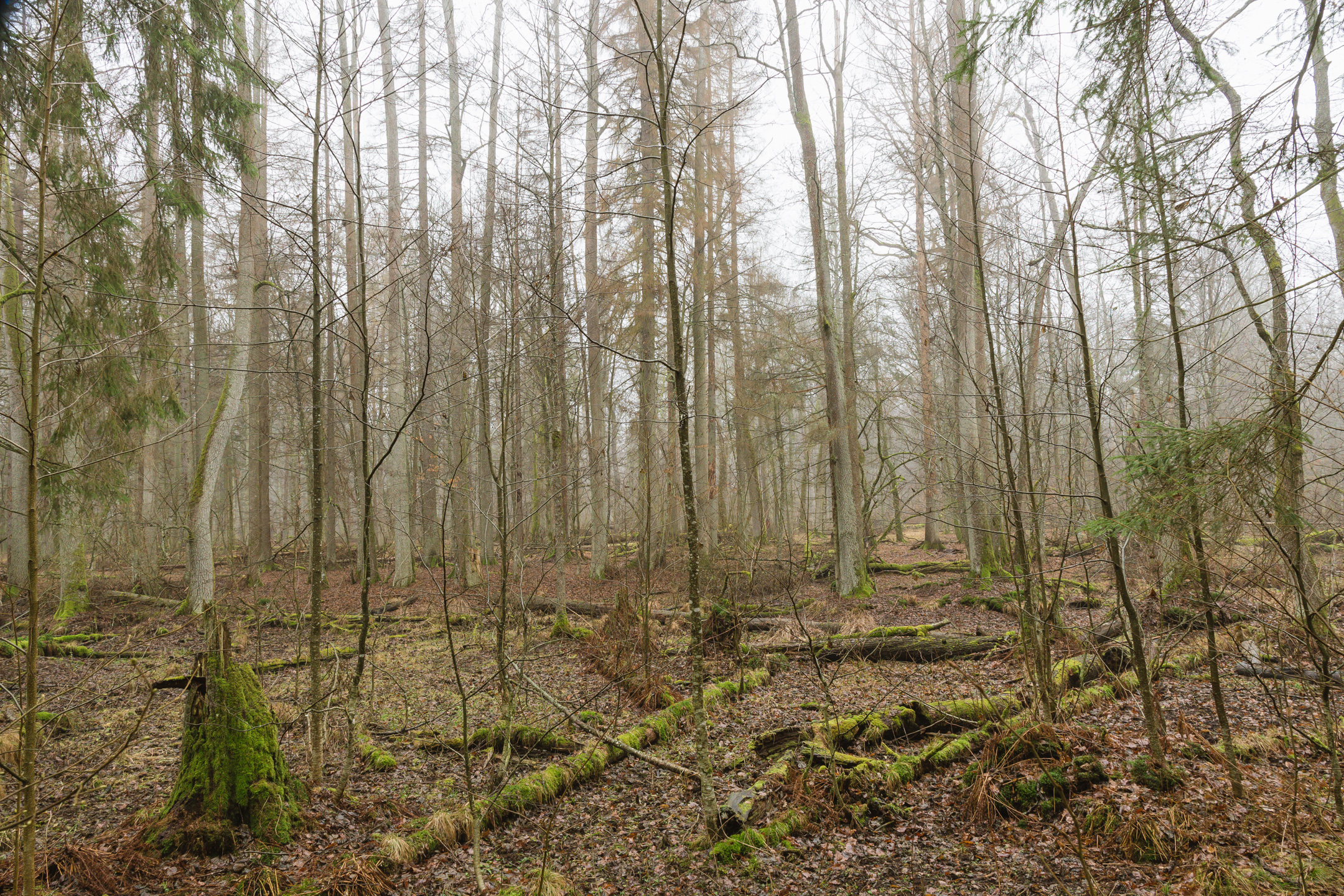
How do wolves shape ecosystems?
Wolves shape ecosystems by impacting herbivores — mainly deer — and smaller carnivores through two pathways. First, by killing prey, they lower prey abundances directly. Second, by instilling fear in prey, they influence prey behaviour. As prey attempt to reduce their probability of being killed, they alter their space use, activity times and vigilance. This in turn affects the plants their prey eat — what ecologists call a trophic cascade. Trees can benefit as a consequence of wolves changing both the numbers and behaviour of deer.
In Białowieża Forest we have found evidence for both direct and indirect wolf impacts, and we have found that these effects cascade down the food chain to plants, which regenerate better in areas of high wolf activity.
Effect 1: Wolves reduce herbivore population sizes
Long-term monitoring of both wolf and herbivore abundances in Białowieża suggests that when wolf densities are high, herbivore populations are suppressed by around 10%. This was a correlative study, so it is difficult to prove cause and effect definitively — but it is the best data available. It is reasonable to expect that ecologically functional densities of wolves elsewhere in Europe would have similar suppressive effects.
Effect 2: Red deer avoid areas of high wolf activity
My colleagues looked into whether different herbivore species avoid areas of high wolf activity across the Białowieża landscape. The results were striking: red deer space use and wolf space use were almost mirror images of each other. Where wolves were most active, red deer were least present, and vice versa.
The same pattern did not hold for moose, bison, roe deer or wild boar — species that wolves predate relatively infrequently and which therefore have less reason to avoid wolf territory.
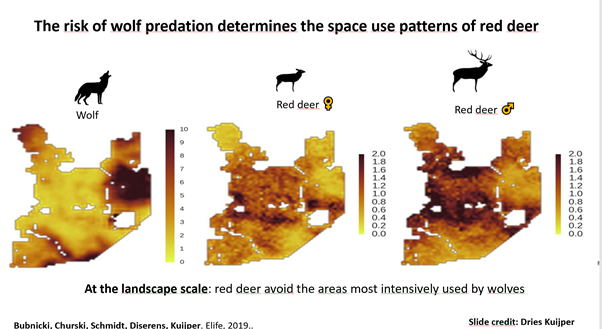
In practical terms, this redistribution of red deer across the landscape means that vegetation in different areas is subject to very different levels of herbivore pressure — with important consequences for forest regeneration.
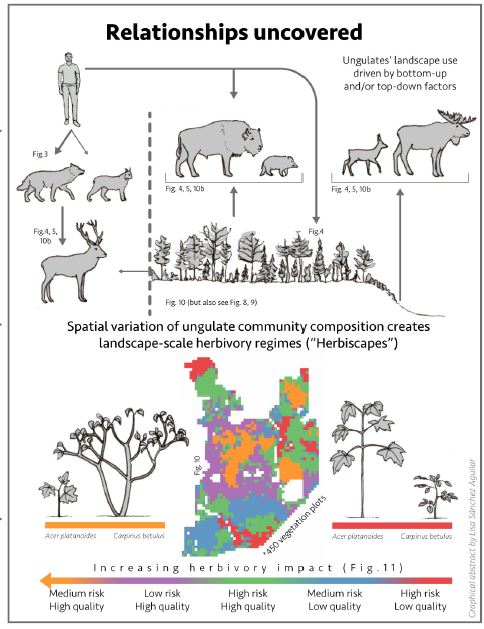
Browsing-intolerant plant species grow better in areas of high wolf activity. My colleagues found the proportion of a common browsing-tolerant tree species increased — and the proportion of a browsing-intolerant species decreased — with increased herbivory pressure. Reference: elifesciences.org/articles/44937
Effect 3: Wolves increase the vigilance of red deer
My colleagues tested whether red deer and wild boar become more vigilant when they detect a wolf scat nearby. Vigilance — the animal raising its head to scan for threats — is a direct measure of perceived risk. This is part of what ecologists call the landscape of fear: the idea that predation risk shapes not just where prey go, but how they behave when they get there.
Red deer were far more vigilant when wolf scat was present than when it was absent. Wild boar showed no response at all. This makes ecological sense: red deer are the wolf’s primary prey in Białowieża, comprising around 80% of the diet, while wild boar account for only 20%.
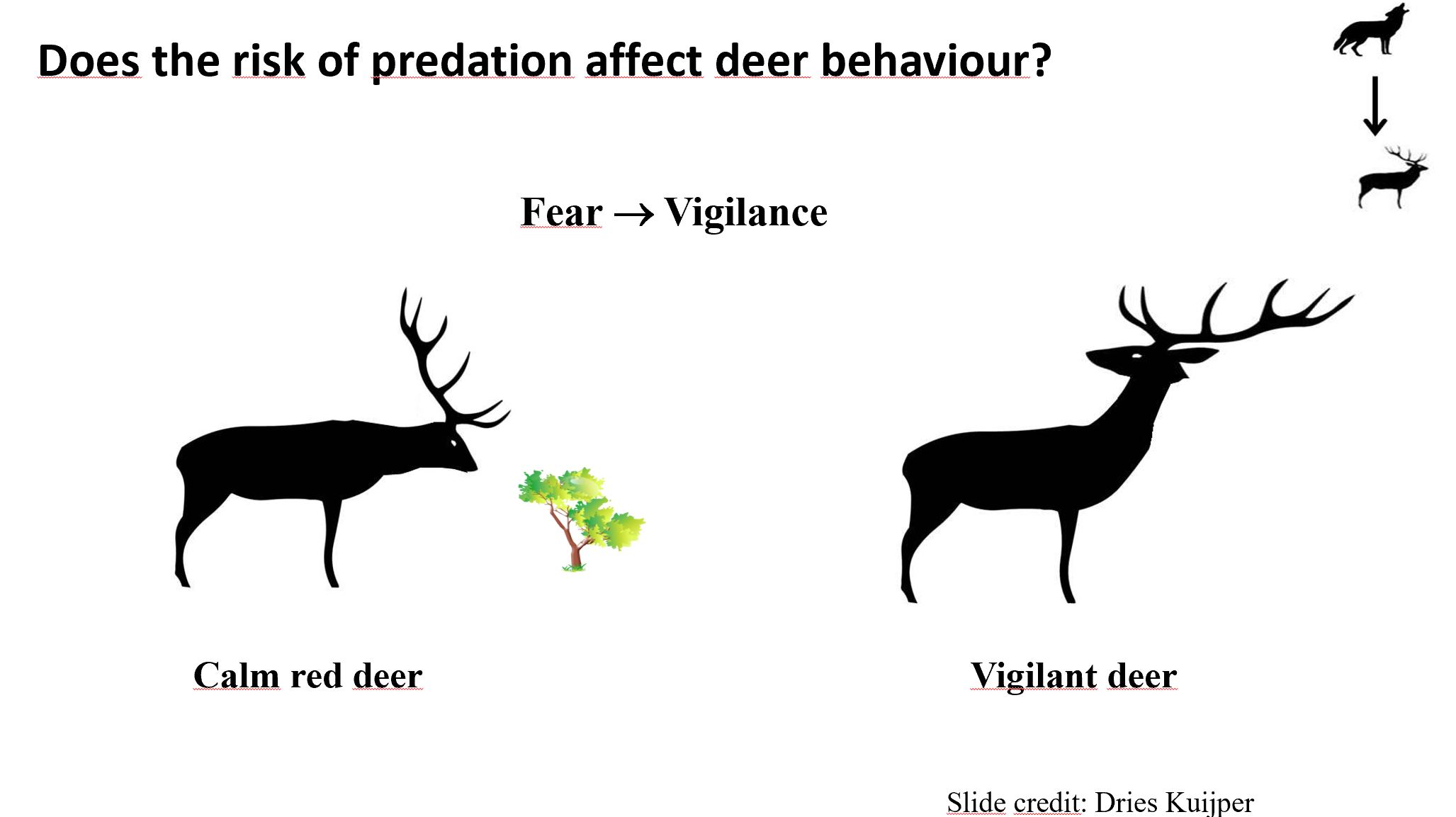
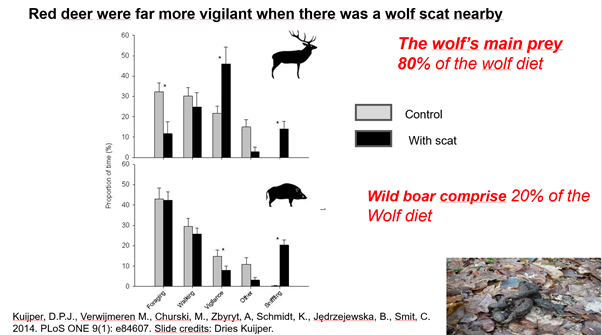
The implications are significant. The more time an animal spends being vigilant, the less time it can spend feeding. Wolf reintroduction should therefore lower red deer fitness and exert downward pressure on deer numbers, as well as reducing foraging in high-risk areas. Reference: doi.org/10.1371/journal.pone.0084607
Effect 4: Fallen tree logs amplify the wolf’s effect on deer behaviour
My colleagues explored whether herbivores increase their vigilance near fallen tree logs. Logs are an escape impediment — they slow a fleeing deer and make it more vulnerable to a pursuing wolf. Deer appear to know this. This is one reason why old-growth forest, with its abundance of fallen deadwood, creates a more complex landscape of fear than managed plantation.
Red deer avoided coming close to tree logs and were more vigilant when logs were nearby. Critically, the strength of this effect depended on how intensively wolves used the local area: deer perceived logs as riskier when wolves were more frequently present. Reference: doi.org/10.1093/beheco/arv150
Effect 5: Herbivore browsing on trees is lower in areas of high wolf activity
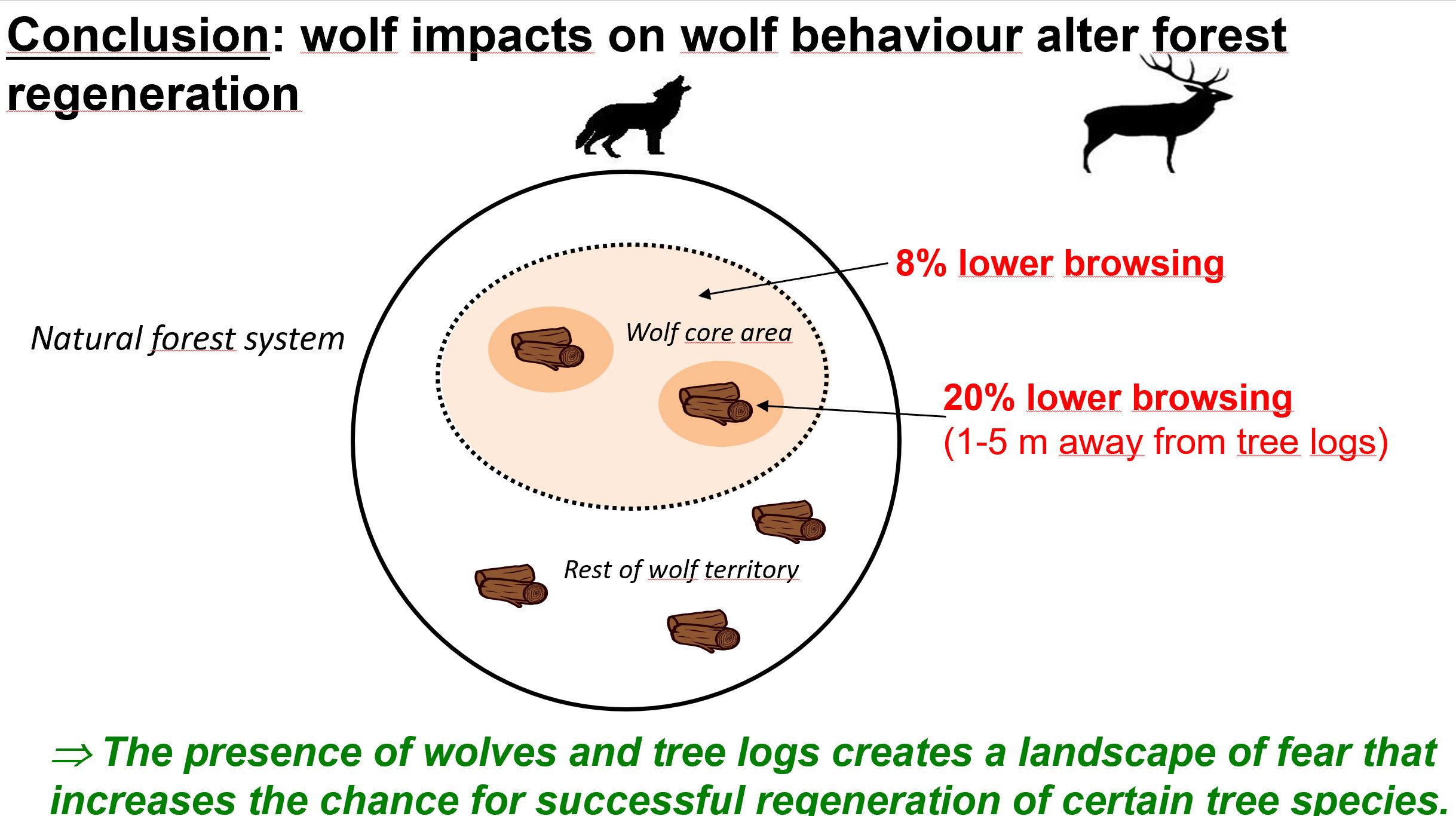
My colleagues found tree browsing intensity was 8% lower in wolf core areas compared to outside them. In areas of high wolf activity where tree logs were also present, browsing was reduced by 20% in the vicinity of the logs. This shows that wolf presence alone is not the sole factor: fine-scale habitat features like fallen logs play an important amplifying role.
Effect 6: The spatial extent of the log effect grows with predation risk
In low-risk areas, fallen logs reduced browsing only within small patches of around 4–6 metres. In high-risk areas, the effect extended to at least 16 metres from the log. The magnitude also differed: browsing intensity was reduced by up to 37% around logs in high wolf-risk areas, compared to less than 20% in low-risk areas.
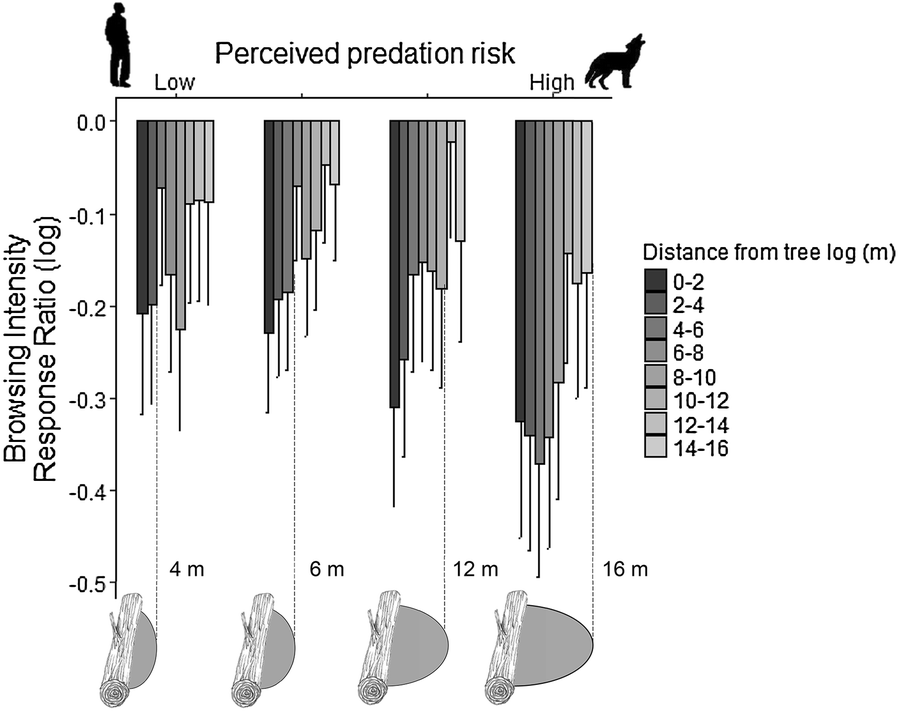
This suggests that to maximise the wolf’s ecological role we should combine wolf presence with a structurally diverse landscape containing escape impediments. Managed plantation forests — the dominant land cover in much of upland Britain — often lack these features entirely. The strictly protected old-growth core of Białowieża, with its dense accumulation of fallen deadwood, is precisely the kind of habitat where these effects are strongest. Reference: doi.org/10.1007/s10021-015-9919-0
Effect 7: Wolf activity alters the diet of red deer but not bison
My colleagues found that red deer in areas of high wolf activity ate more deciduous tree species and fewer forbs than deer in low wolf-use areas. Bison — which wolves rarely predate — showed no such dietary shift.
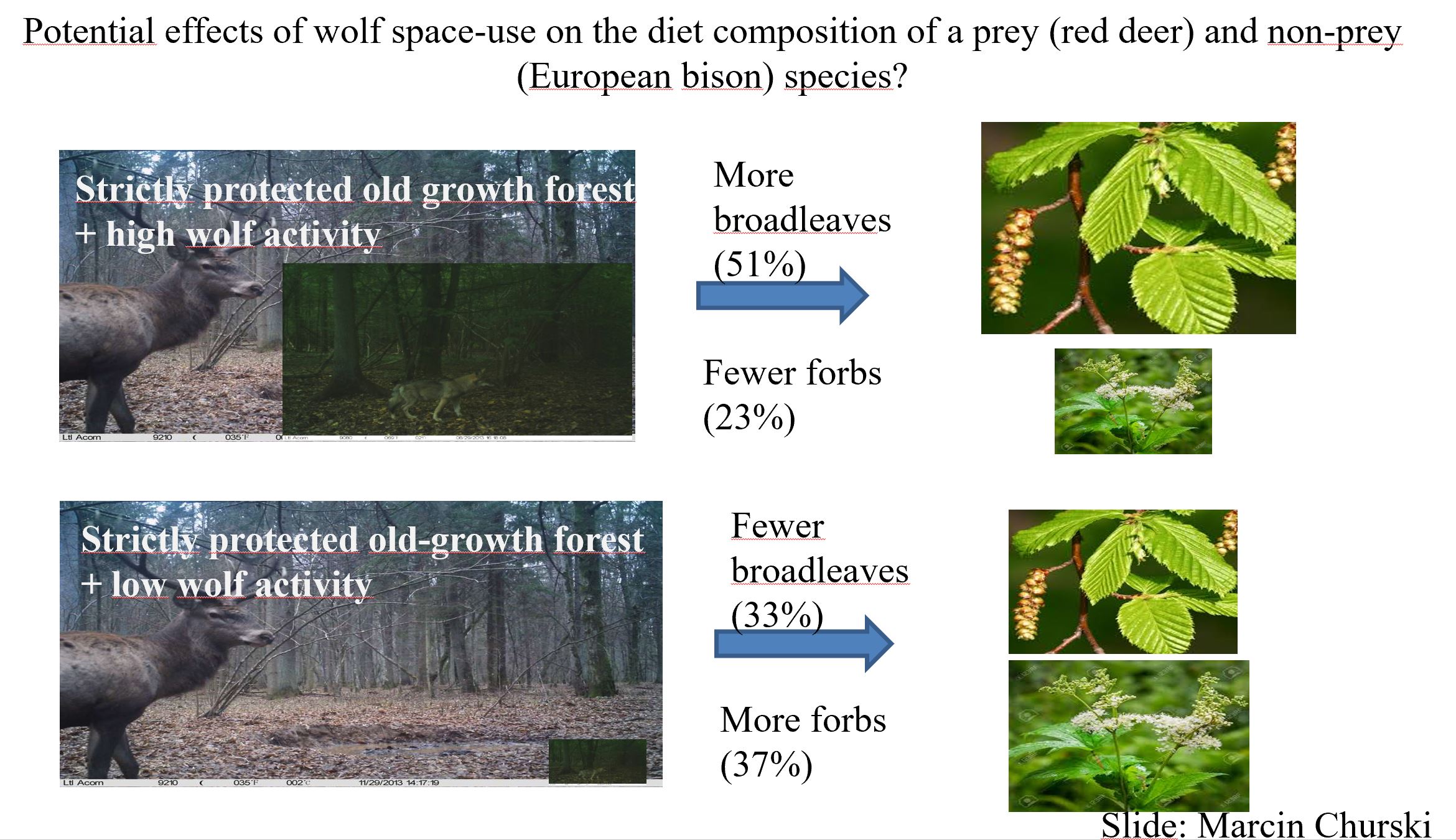
One important caveat: these dietary effects were only observed in Białowieża National Park, the strictly protected old-growth core. They did not appear in the surrounding managed forest, where monoculture plantations and hunting pressure likely override the wolf’s influence. Wolves may therefore play a limited role in shaping deer diet in areas with high human impact. Reference: doi.org/10.1016/j.foreco.2017.01.033
Summary
The evidence from Białowieża Forest points to a consistent set of wolf effects: herbivore abundances are suppressed by around 10% when large carnivore densities are high; red deer, particularly females, redistribute away from areas of high wolf activity; other herbivore species show no spatial response; herbivore browsing is 8% lower in wolf core areas, and 20% lower near fallen logs in those areas; and areas of high wolf activity combined with fallen logs appear to support improved tree regeneration. In strictly protected old-growth forest, red deer in high wolf-activity areas also shift their diet toward more deciduous broadleaves.
What does this mean for Scotland?
That is a harder question to answer than it might appear. The vast open landscapes of the Scottish Highlands — with their high deer densities and largely treeless terrain — differ enormously from the closed-canopy forests of Białowieża. Deer in Scotland are often food-limited, and may have little choice but to forage in high-risk areas even in the presence of wolves, potentially dampening the behavioural effects we observe here.
Wolves will kill some deer and lower their abundances to some degree. They will also scare deer and alter their behaviour. But the magnitude and ecological consequences of these effects in a Scottish context are difficult to predict with any precision. What I am confident in saying is that if we stop persecuting wolves, they will return — and where they return, the evidence suggests ecosystems become richer and more dynamic.
Go deeper
Explore the forest with an expert
Five days tracking wolves, finding bison and walking ancient old-growth — guided by a PhD ecologist who has spent years researching here.
View the tour →Frequently asked questions
Do wolves actually cause trophic cascades?
The evidence from Białowieża is that wolves do suppress herbivore abundances and alter herbivore behaviour in ways that benefit plant regeneration. Whether this constitutes a full trophic cascade depends on definition, but the downstream effects on vegetation are measurable and consistent. The famous Yellowstone trophic cascade is often overstated — the reality, as in Białowieża, is more nuanced and context-dependent.
Would wolves solve the deer problem in Scotland?
Not on their own. Scotland’s deer problem is the product of centuries of land management, the absence of natural predators, and active encouragement of high deer numbers for stalking. Wolves would exert downward pressure on deer populations and alter their behaviour, but the landscape context — open, treeless, with food-limited deer — is very different from Białowieża. The effects would likely be smaller than many advocates predict.
Are wolves dangerous to humans?
Wolves are exceptionally wary of humans. Despite years of working in wolf territory in Białowieża, I have never seen one in the wild. There have been no documented wolf attacks on humans in Poland for decades. The risk wolves pose to people is vanishingly small compared to, for instance, road traffic or domestic dogs.
What about livestock?
Livestock predation is a genuine concern and should not be dismissed. Wolves in Poland do kill sheep and occasionally cattle, particularly where livestock is unguarded. Effective mitigation — livestock guardian dogs, electric fencing, improved husbandry — significantly reduces losses. Compensation schemes exist in most European countries where wolves are present. The conflict is manageable, but it requires investment and political will.